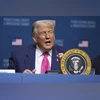
US President Donald Trump on Wednesday said the United States is “very close to a deal with India,” suggesting that American goods could soon gain greater access to the Indian market, according to a Reuters report. “We're very close to a deal with India, where they open it up,” Trump said during a bilateral meeting at the Oval Office with Bahrain’s Crown Prince and Prime Minister, Salman bin Hamad Al Khalifa.
He added, “We’ve made deals with a lot of great places. We have another one coming up — maybe with India. I don’t know, we’re in negotiation. When I send out a letter, that’s a deal.”
He reiterated on Wednesday: “We have another deal coming up — maybe with India — and we have some pretty good deals to announce.” He further noted that the United States would “probably live by the letter” of its agreement with Japan and hinted at broader action involving several smaller economies. “The big one really is going to be on the 150 countries that we're really not negotiating with, and they're smaller — we don't do much business with,” he said.
India may face tariffs similar to Indonesia
Trump’s latest remarks follow Tuesday’s announcement that Indonesia will face a 19 per cent tariff on exports to the US — reduced from the 32 per cent initially proposed — under a new bilateral agreement. In return, the US will gain tariff- and non-tariff-barrier-free access to the Indonesian market.
He said any forthcoming agreement with India would be “on the same line” as the one with Indonesia, indicating that India may also face tariffs above the 10 per cent mark under a proposed interim deal.
Over 150 countries to receive tariff notices
Trump revealed plans to send formal notifications to more than 150 countries, outlining the tariff rates they would face under the new trade policy. “We’ll have well over 150 countries that we’re just going to send a notice of payment out, and the notice of payment is going to say what the tariff rate will be,” he said at the White House. “It’s all going to be the same for everyone, for that group.”
He clarified that these countries are primarily smaller economies with limited trade volume with the US.
Pressure mounts on trading partners
The US administration has extended the deadline for countries to renegotiate terms to August 1, providing a three-week window beyond the earlier July 9 cut-off. The extension has sparked activity among nations aiming to avoid steep new tariffs.
Although earlier signals suggested that the US would pursue formal bilateral negotiations, Trump is now positioning the letters as instruments of trade policy — effectively treating them as “deals” without negotiation. Still, he indicated that countries willing to engage could negotiate lower rates.
Uncertainty looms over global markets
The tariff notifications have heightened unease among global markets and trade blocs. While many of the proposed rates were initially floated in April — and then paused due to market volatility — their formal rollout has reintroduced uncertainty.
Trading partners such as the European Union, which had been expecting to finalise tentative deals with the US, have been particularly surprised by the move, which signals a shift away from traditional negotiation-based policymaking.

 "Trump hints at trade deal with India, says major announcements on the way")


