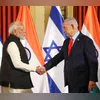
India and Israel on Thursday signed 16 agreements spanning artificial intelligence (AI), mineral exploration, defence, and mobility and announced 10 other initiatives, including allowing 50,000 additional Indian workers in Israel over the next five years. The two countries committed to joint development, joint production, and transfer of technology in the defence sector.
The next round of negotiations on the trade deal will take place in May, the commerce ministry said after four days of talks between the Indian and Israeli trade delegations concluded on Thursday in New Delhi.
On the second day of the PM’s visit to Israel, Modi and
Netanyahu elevated the India-Israel strategic partnership to a new level — a “special strategic partnership for peace, innovation, and prosperity”. In his remarks at a joint media briefing, Modi said India and Israel concluded a bilateral investment agreement last year and “will also soon finalise a mutually beneficial FTA”.
The two sides also signed agreements, including one to establish a critical and emerging technologies partnership to “impart fresh momentum to cooperation in areas such as AI, quantum technology, and critical mineral”. Modi said the two countries would add new dimensions to the defence agreement signed in November last year. “Together, we will advance towards joint development, joint production, and transfer of technology,” he said, adding that cooperation would also be strengthened in areas such as civil nuclear energy and space.
India and Israel decided to deepen cooperation in agriculture by increasing the number of centres of excellence established in India with Israel’s support from 43 to 100 and by setting up “villages of excellence”. The two sides also agreed to establish an India-Israel Innovation Centre for Agriculture in India.
Modi said the two countries would promote regional connectivity and “move forward with renewed momentum” on the India-Middle East–Europe Economic Corridor and the India–Israel–United Arab Emirates–US (I2U2) grouping.
On terrorism, the PM said India and Israel are unequivocal in their position that terrorism has no place in the world and cannot be accepted in any form or manifestation. “Peace and stability in West Asia are directly linked to India’s security interests,” Modi said, adding that India supports dialogue and the peaceful resolution of issues. “The Gaza peace plan has opened a pathway towards peace,” he said.
A joint statement released later in the day said Modi’s historic visit to Israel in 2017 and Netanyahu’s visit to India in 2018 “laid the foundation for a new era of partnership and collaboration” across diverse domains. The two leaders said Indian and Israeli capabilities complement each other — Israel as a global powerhouse of technology and innovation, and India as a hub of talent, manufacturing excellence, and entrepreneurial energy.
According to the joint statement, the two countries will seek to integrate their science and technology establishments. A new initiative on critical and emerging technologies will be led by the national security advisors of both countries. Contributions to the India-Israel joint research calls will be increased from $1 million to $1.5 million each to promote joint research between Indian and Israeli universities.
The two sides also signed a declaration of intent to cooperate on establishing a horizon scanning and strategic foresight mechanism to identify emerging global trends in areas such as technology, the economy and society, by leveraging data, AI, and expert insights to support strategic planning and decision-making. India and Israel will also foster dialogue between their national cyber authorities and set up an India-Israel centre of excellence in cybersecurity in India.
Israel invited greater Indian participation in its infrastructure sector, particularly in light of major upcoming projects in Metro rail, roads, airports, desalination plants, and wastewater treatment facilities.
On mobility, Israel will allow up to 50,000 additional Indian workers over the next five years across sectors, including manufacturing, restaurant and café, retail, cleaning, logistics, warehousing, hospitality, recycling, textile, metal, electronics, chemical, food processing, wood and paper, plastic, rubber, and other industrial segments.
During 2024-25, amid regional instability, India’s exports to Israel fell 52 per cent to $2.14 billion from $4.52 billion in 2023-24. Imports declined 26.2 per cent to $1.48 billion, taking bilateral trade to $3.62 billion. India is Israel’s second-largest trading partner in Asia.
In Jerusalem, Modi invited Israeli technology companies to invest in India and partner Indian youth as he visited an exhibition showcasing innovations in AI, healthcare, and agriculture. He also visited the Yad Vashem memorial to pay tribute to the victims of the Holocaust. Later in the day, Modi met the cast and crew of the Israeli espionage series Fauda.

 "From defence to tech collaboration: 16 pacts reshape India-Israel ties")


