Associate Sponsors

Co-sponsor

From the brink and back: How the India-US trade deal finally shaped up

After months of tariff shocks, stalled talks and diplomatic sparring, India and the US finally stitched together a trade deal that reshaped bilateral ties
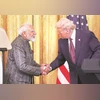
Prime Minister Narendra Modi and US President Donald Trump met in Washington on February 13 last year. (Photo: Reuters)
Asit Ranjan Mishra New Delhi
3 min read Last Updated : Feb 03 2026 | 11:42 PM IST
In February last year, when Prime Minister Narendra Modi and US President Donald Trump announced to negotiate a ‘mutually beneficial, multi-sector’ Bilateral Trade Agreement (BTA) during the former’s visit to Washington DC, observers thought India has the first mover advantage over other countries in sealing a trade deal to avoid the ‘reciprocal tariff’ by the US.
 
But progress halted as the two sides clashed over market access, with India unwilling to liberalise its politically sensitive dairy and agriculture sectors.
 
To show flexibility, India had rolled out a series of concessions to the US in February last year: From cutting import duties on Harley-Davidson motorcycles, withdrawing the so-called Google tax on digital advertising, and later rolling back a host of quality control orders. 
Yet Trump’s approach remained unpredictable. He blindsided New Delhi by doubling the already punitive 25 per cent tariff to 50 per cent, effective August 27 last year, citing India’s continued purchase of Russian oil. After February last year, Modi and Trump avoided direct engagements as the American President repeatedly claimed credit for averting a nuclear conflict between India and Pakistan following the escalation after the Pahalgam terror attack. Publicly, Trump oscillated between calling Modi a ‘close friend’ and dismissing India as a ‘dead economy’.
 
Throughout 2025, his senior officials echoed his hardline. Treasury secretary Scott Bessent accused India of ‘fuelling Russian war machine’, commerce secretary Howard Lutnick declared ‘we need to fix India’, the US trade representative Jamieson Greer called India a ‘tough nut to crack’, and White House trade advisor Peter Navarro alleged that ‘Brahmins profiteering off Indian people’ and described India as the ‘India is maharaja of tariffs’.
 
Indian officials, however, remained measured in their response, choosing not to respond to most provocations.
 
In October, India signalled buying more energy products from the US and reduced oil purchases from Russia after US sanctions starting the same month. However, it didn’t significantly move the needle towards a trade deal.
 
While India hoped for overall tariff to be reduced to 15 per cent, the US was reluctant to grant India a tariff advantage over regional competitors such as Pakistan (19 per cent), Bangladesh (20 per cent) and Indonesia (19 per cent), given India’s ‘limited’ market liberalisation offer.
 
The turning point came with the appointment of Sergio Gor as the US ambassador to India. A long-time Trump aide, Gor had earlier served as director of the White House Presidential Personnel Office, where he oversaw hiring across the administration.
 
In his first public address after taking over as ambassador, Gor on January 12 said it is not an easy task to get the trade deal across the finish line, but “we are determined to get there”.
 
“Real friends can disagree, but always resolve their differences in the end,” Gor observed.
 
It was Gor who first hinted at a breakthrough on Monday evening, posting “STAY TUNED…” on X shortly after Trump and Modi spoke. The post sent the GIFT Nifty surging, minutes before the formal announcements from both leaders. The rest, as they say, is history.

One subscription. Two world-class reads.

Already subscribed? Log in

Subscribe to read the full story →
*Subscribe to Business Standard digital and get complimentary access to The New York Times

Smart Quarterly

₹900

3 Months

₹300/Month

SAVE 25%

Smart Essential

₹2,700

1 Year

₹225/Month

SAVE 46%
*Complimentary New York Times access for the 2nd year will be given after 12 months

Super Saver

₹3,900

2 Years

₹162/Month

Subscribe

Renews automatically, cancel anytime

Here’s what’s included in our digital subscription plans

Exclusive premium stories online

  • Over 30 premium stories daily, handpicked by our editors

Complimentary Access to The New York Times

  • News, Games, Cooking, Audio, Wirecutter & The Athletic

Business Standard Epaper

  • Digital replica of our daily newspaper — with options to read, save, and share

Curated Newsletters

  • Insights on markets, finance, politics, tech, and more delivered to your inbox

Market Analysis & Investment Insights

  • In-depth market analysis & insights with access to The Smart Investor

Archives

  • Repository of articles and publications dating back to 1997

Ad-free Reading

  • Uninterrupted reading experience with no advertisements

Seamless Access Across All Devices

  • Access Business Standard across devices — mobile, tablet, or PC, via web or app

Topics :Donald TrumpNarendra ModiIndia US Trade Dealtrade agreementsUS tariffs

Next Story


