Home / Economy / News / India-EU trade deal: Top questions answered on trade, tariffs, and more
India-EU trade deal: Top questions answered on trade, tariffs, and more
India and the EU have signed a free trade agreement aimed at boosting exports, jobs and mobility. Here are key FAQs on tariffs, farmers and services under the trade deal
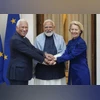
Prime Minister Narendra Modi with European Council President Antonio Costa, left, and European Commission President Ursula von der Leyen, right, in New Delhi. (Photo: PTI)
3 min read Last Updated : Jan 30 2026 | 11:26 AM IST
Prime Minister Narendra Modi, along with the president of the European Union Commission Ursula von der Leyen, announced a mega trade deal between the EU and India on Tuesday, which has been dubbed as the 'mother of all deals'.
PM Modi said the India-EU Free Trade Agreement (FTA) covers economies that together account for about 25 per cent of global gross domestic product (GDP) and nearly one-third of global trade. The agreement is expected to come into force within a year.
Trade between India and the EU stood at $136.5 billion in the financial year ending March 2025.
Below are key questions and answers released by the Ministry of Commerce and Industry explaining the scope and impact of the India-EU FTA.
How much merchandise trade does India have with the EU?
India’s total merchandise trade with the EU was $136.54 billion in 2024-25. Trade has grown strongly over the last four years.
India’s merchandise exports to the EU rose at a compound annual growth rate (CAGR) of 16.4 per cent, increasing from $41.36 billion in 2020-21 to $75.85 billion in 2024-25.
What benefits can India expect for its exports under the agreement?
The EU has agreed to remove duties on about 70.4 per cent of tariff lines immediately. This covers nearly 90.7 per cent of India’s export value.
Another 20.3 per cent of products will see tariffs phased out over time. In total, EU concessions cover almost 97 per cent of tariff lines and over 99 per cent of trade value.
What tariff concessions has India offered to the EU?
India will provide immediate duty-free access on around 49.6 per cent of tariff lines, covering 30.6 per cent of trade value.
Another 39.5 per cent of tariff lines, representing 63.1 per cent of trade value, will see duties removed gradually over five, seven or 10 years from the agreement’s start. Overall, India’s offer covers 92.1 per cent of tariff lines and 97.5 per cent of trade value, while protecting sensitive sectors.
Which products has the EU excluded from tariff concessions?
The EU has kept certain sensitive items outside the scope of tariff cuts. These include meat and meat offal, dairy products, honey, rice, sugar and tobacco.
How will the India-EU trade deal be managed?
A Joint Committee with representatives from India and the EU will oversee the agreement. It will monitor implementation, resolve interpretation issues, explore ways to expand trade, and supervise specialised committees dealing with technical and sector-specific matters.

 "India-EU trade deal: Top questions answered on trade, tariffs, and more")


