The US Supreme Court’s (SC) decision to strike down tariffs imposed under emergency powers, followed by President Donald Trump’s announcement of a temporary 10 per cent global import levy, has altered the tariff framework affecting Indian exports to the American market.
The development has lowered the reciprocal tariff burden on Indian goods for now, but it has also introduced fresh uncertainty into the ongoing India–US trade negotiations. This article sets out what existed earlier, what changed after the ruling, and what it means for Indian companies and the bilateral trade pact.
What existed before the US SC's ruling?
Before the court's decision, Indian exports to the United States faced multiple layers of duties under a reciprocal tariff structure introduced by Washington in 2025. These tariffs were imposed in addition to standard most-favoured-nation (MFN) duties.
In April 2025, the US administration announced reciprocal tariffs on about 60 countries, including India, to match the duties these countries imposed on American goods. By July, Washington had set a 25 per cent reciprocal tariff on Indian imports, effective from August 2025. A further 25 per cent penalty was added for India’s purchase of Russian crude oil, taking the total additional duty on some Indian goods to 50 per cent.
Under an interim understanding reached in February this year, the US said it would remove the Russia-related penalty and lower the reciprocal tariff on India. However, until recently, Indian exports were still facing a 25 per cent reciprocal tariff in addition to MFN duties.
Tariffs are customs duties paid by importers when goods enter a country. In practice, companies often pass these costs to consumers, making imported goods more expensive in the destination market.
The US has argued that it faces a trade deficit with India and that higher Indian tariffs restrict American exports. The reciprocal tariff policy was introduced to match duties imposed on US goods and push for market access.
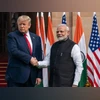
During his press conference on Friday, when asked what would change with Washington's deal with New Delhi, he said, "India and I think PM Modi is a great gentleman. It is a fair deal. We are not paying tariffs, but they are. We did a little flip there."
What the Supreme Court's ruling changed?
The US Supreme Court ruled that President Donald Trump could not rely on the International Emergency Economic Powers Act (IEEPA) to impose sweeping tariffs on imports.
The justices said the law allowed the president to regulate certain economic transactions during emergencies but did not authorise the imposition of tariffs. They added that Congress retained primary authority over duties and trade taxes.
The decision invalidated the tariff regime introduced under that emergency law and placed limits on the use of such powers for broad trade measures. However, the ruling did not prohibit tariffs imposed under other statutes, leaving room for the administration to pursue duties through alternative legal routes.
Trump’s response and the new 10% tariff
Following the ruling, Trump said “nothing changes” in Washington’s trade deal with India and described the agreement as a “fair deal”. He said he was proud of his trade policy and had “powerful alternatives” to impose tariffs.
As he announced during his press conference on Friday, he later signed an executive order introducing a temporary 10 per cent global tariff on imports into the United States, in addition to existing duties. A proclamation dated February 20 said the 10 per cent surcharge would apply for 150 days from February 24, 2026.
Under the new framework, instead of different reciprocal tariffs for different countries, a uniform 10 per cent levy applies to goods that were earlier covered under the reciprocal tariff regime.
For example, if an Indian product faced a 5 per cent MFN duty in the US, the effective duty earlier stood at 30 per cent when a 25 per cent reciprocal tariff applied. Under the new arrangement, the same product would face 15 per cent: the 5 per cent MFN rate plus the 10 per cent temporary surcharge.
As a result, the effective reciprocal tariff burden on Indian goods fell to 10 per cent from 25 per cent from February 24.
What changes for India?
Tariff burden: Indian exports now face a temporary 10 per cent additional duty instead of the earlier 25 per cent reciprocal tariff. This marks a reduction in the immediate tariff burden on many goods.
Russian oil penalty: The earlier additional penalty related to Russian crude purchases was removed earlier this month, reducing the overall duty before the new global surcharge was announced.
Uniform structure: The earlier country-specific reciprocal tariff structure has been replaced with a uniform 10 per cent levy for the goods covered by that framework.
What does not change?
Sectoral tariffs: Sector-specific tariffs imposed under other US trade laws remain in place. These include duties on steel, aluminium and copper, which stand at about 50 per cent, and some auto components facing 25 per cent tariffs.
Bilateral negotiations: India and the United States continue to work on the first phase of a bilateral trade agreement. Officials from both sides are scheduled to meet in Washington to finalise the legal text. The agreement is expected to be signed next month and may be operational by April, according to Indian officials.
Prime Minister Narendra Modi earlier said sensitive sectors such as dairy and agriculture had been safeguarded. Commerce and Industry Minister Piyush Goyal said the two sides were moving towards finalising the pact.
Trade relationship: The US remains India’s largest trading partner in goods. Between 2021 and 2025, it accounted for about 18 per cent of India’s exports. Bilateral goods trade reached about $186 billion in 2024–25, with India running a surplus of around $41 billion.
Why analysts want a review?
With the reciprocal tariff on Indian goods effectively falling to 10 per cent from 25 per cent, analysts said the basis for tariff concessions under the proposed trade pact may need reassessment.
Ajay Srivastava, founder of the Global Trade Research Initiative, said India had agreed to reduce duties on US goods when Washington planned to lower the reciprocal tariff to 18 per cent. With the new uniform rate now at 10 per cent for all countries, he said India should evaluate whether the gains under the proposed deal remained balanced.
“Deals are not charity. Both sides must gain. Now, India’s gains need fresh evaluation,” he said.
Issued earlier this month, a White House fact sheet said certain goods would be exempt from the temporary surcharge. These include some critical minerals, energy products, fertilisers, certain agricultural goods, pharmaceuticals, some electronics, specific vehicles and aerospace products. The exemptions were meant to address domestic supply needs and broader economic considerations.
What to watch next?
The temporary 10 per cent surcharge applies for 150 days, leaving open the possibility of further changes depending on negotiations and legal developments. While the court ruling removed one legal route for sweeping tariffs, the administration retains authority under other trade laws.
For India, the immediate effect is a lower additional tariff on exports to the US. However, with negotiations on a bilateral trade agreement under way and tariff powers still being exercised through other statutes, the broader trade relationship remains in flux.

 "Explained: What Trump's 10% global import tariff reset means for India")


 Connect with us on WhatsApp