Natural gas, nuclear energy get renewed push from Trump-Modi trade talks

In a joint statement, PM Narendra Modi and US President Donald Trump reaffirmed their commitment to increase energy trade
Modi, Narendra Modi, Donald Trump, Trump
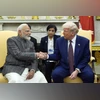
President Donald Trump meets with India's Prime Minister Narendra Modi in the Oval Office of the White House, Thursday, Feb. 13, 2025, in Washington. (Photo: PTI)
Subhayan ChakrabortyShreya Jai New Delhi
4 min read Last Updated : Feb 14 2025 | 11:29 PM IST
India’s efforts to build a multi-fuel basket to power its energy security were reinforced when Prime Minister Narendra Modi and American President Donald Trump announced the two countries’ partnership in natural gas and nuclear power.
 
In a joint statement, Modi and Trump reaffirmed their commitment to increase trade in energy to position the United States (US) as a leading supplier of crude oil, petroleum products, and liquefied natural gas to India, in line with growing needs and priorities of “our dynamic economies”.
 
“The leaders committed to enhance investments, particularly in oil and gas infrastructure, and facilitate greater cooperation between the energy companies of the two countries,” the statement issued early Friday morning said.
 
Petroleum and Natural Gas Minister Hardeep Singh Puri on Friday said the joint statement signalled what had been happening.
 
“There’s already substantial energy cooperation between the US and India. Many (nations) want to sell gas to us. We are in the market for more gas. Already, we have a very substantial relationship with the US, mostly on gas. I see these quantities rising,” Puri said at India Energy Week.
 
The US is understood to have shown commitment to ramping up exporting liquefied natural gas (LNG) soon. The confidence is based on Trump signing an executive order allowing the US government to resume processing export-permit applications for new LNG projects soon after he took office last month. 
 
A year ago, the Joe Biden administration had announced a temporary pause on pending decisions on exporting LNG to nations with which it did not have a free-trade agreement (FTA) until the US’s Department of Energy could update the underlying analyses for authorisation. India does not have an FTA with the US.
 
Indian officials have said the speed at which the US clears these export applications will also set the pace for how soon more LNG can begin flowing between the countries. The US is the largest LNG exporter worldwide, with shipments expected to double by the end of this decade.
 
Neither side has given much detail on the volumes of gas that may reach India from the US or the timeline of when LNG export will galvanise.
 
However, officials of public-sector oil-marketing companies (OMCs) at the India Energy Week said formal talks on long-term contracts were some time away. Instead, spot buying from the US may rise.
 
“The announcements signal a major shift in the energy trade. In the next few months, as and when purchases are made, special attention may be given to US volumes,” an official with an OMC said.
 
The two leaders also announced their commitment to realising the US-India 123 Civil Nuclear Agreement by proceeding with plans to work together to build US-designed nuclear reactors in India through large-scale localisation and possible technology transfer.
 
“Both sides welcomed the recent Budget announcement by Government of India to take up amendments to the Atomic Energy Act and the Civil Liability for Nuclear Damage Act (CLNDA) for nuclear reactors, and further decided to establish bilateral arrangements in accordance with CLNDA, that would address the issue of civil liability and facilitate the collaboration of Indian and US industry in the production and deployment of nuclear reactors,” the statement said.
 
In order to increase private-sector participation in the nuclear sector, the Union finance minister in her Budget speech proposed amendments to the Atomic Energy Act and the CLNDA. The Budget also proposed a ₹20,000 crore “Nuclear Energy Mission for Research & Development of Small Modular Reactors” (SMR), at least five of which will be indigenously developed and operationalised by 2033.
 
Several private players in India have announced plans to foray into nuclear energy. Tata Power, Jindal Steel & Power, Larsen & Toubro are some of the firms that have publicly announced their interest in nuclear whenever the sector opens up. Experts said relaxing the law on nuclear damage would be a game changer because SMR technology required nuclear waste. To meet its target of 500 Gw of non-fossil fuel energy by 2030, India has decided to scale up nuclear energy, which has remained stagnant at 8 Gw for several years.
 

One subscription. Two world-class reads.

Already subscribed? Log in

Subscribe to read the full story →
*Subscribe to Business Standard digital and get complimentary access to The New York Times

Smart Quarterly

₹900

3 Months

₹300/Month

SAVE 25%

Smart Essential

₹2,700

1 Year

₹225/Month

SAVE 46%
*Complimentary New York Times access for the 2nd year will be given after 12 months

Super Saver

₹3,900

2 Years

₹162/Month

Subscribe

Renews automatically, cancel anytime

Here’s what’s included in our digital subscription plans

Exclusive premium stories online

  • Over 30 premium stories daily, handpicked by our editors

Complimentary Access to The New York Times

  • News, Games, Cooking, Audio, Wirecutter & The Athletic

Business Standard Epaper

  • Digital replica of our daily newspaper — with options to read, save, and share

Curated Newsletters

  • Insights on markets, finance, politics, tech, and more delivered to your inbox

Market Analysis & Investment Insights

  • In-depth market analysis & insights with access to The Smart Investor

Archives

  • Repository of articles and publications dating back to 1997

Ad-free Reading

  • Uninterrupted reading experience with no advertisements

Seamless Access Across All Devices

  • Access Business Standard across devices — mobile, tablet, or PC, via web or app

Topics :Donald TrumpNarendra ModiUS India relations bilateral tiesnatural gasnuclear power

Next Story


