Home / Economy / News / 'Omanisation' last key issue in concluding India-Oman FTA talks: Official
'Omanisation' last key issue in concluding India-Oman FTA talks: Official
Omanisation is a policy implemented by Oman to boost the employment of its citizens in the private sector. The policy mandates companies to meet specific quotas for hiring Omani nationals
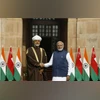
Prime Minister Narendra Modi meets Sultan of Oman Haitham Bin Tarik (Photo: ANI)
The negotiations for the proposed India-Oman free trade agreement are nearing conclusion with both sides discussing the last issue of the Gulf country's labour-related 'Omanisation' policy, as New Delhi wants the current regime to remain unchanged for its workers, an official said.
Omanisation is a policy implemented by Oman to boost the employment of its citizens in the private sector. The policy mandates companies to meet specific quotas for hiring Omani nationals. These quotas vary by sector and are periodically revised.
"There is a requirement in Oman for companies to employ a specified percentage of Omani nationals, which varies by sector - 15 per cent or 20 per cent or 30 per cent...What we want is that this current regime of Omanisation should remain permanent for us, so that it does not become more restrictive in the future after the FTA is finalised," the official said.
The negotiations received a much-needed impetus after the visit of Commerce and Industry Minister Piyush Goyal to Muscat in January this year.
The talks for the agreement, officially dubbed the Comprehensive Economic Partnership Agreement (CEPA), formally began in November 2023.
In such agreements, two trading partners either significantly reduce or eliminate customs duties on a maximum number of goods traded between them. They also ease norms to promote trade in services and attract investments.
Oman is the third largest export destination among the Gulf Cooperation Council (GCC) countries for India. India already has a similar agreement with another GCC member UAE which came into effect in May 2022.
The bilateral trade was about $9 billion (exports $4.42 billion and imports $4.52 billion) in 2023-24.
India's key imports are petroleum products and urea. These account for over 70 per cent of imports. Other key products are propylene and ethylene polymers, pet coke, gypsum, chemicals, and iron and steel.

 "'Omanisation' last key issue in concluding India-Oman FTA talks: Official")

