The
Bharatiya Janata Party (BJP) has secured a decisive victory in the
Delhi Assembly elections, ending a 27-year-long wait for power in the national capital. This landslide victory also marks the downfall of the
Aam Aadmi Party (AAP), which had ruled Delhi for over a decade. But how did BJP manage to turn the tables after trailing by nearly 15 per cent in vote share against AAP in the previous elections? Let’s break it down.
BJP’s breakthrough in jhuggis
For over a decade, AAP enjoyed unwavering support from Delhi’s poor, particularly in slum clusters, thanks to its free electricity and water schemes. However, this time, BJP made significant inroads by offering a powerful counter-strategy.
READ: Delhi Election Winners Full List A relentless campaign, combined with the promise of a pucca house for slum dwellers and the assurance of continuing free utilities, helped BJP cut into AAP’s stronghold. The party also successfully split the 20 per cent Dalit vote—historically aligned with AAP—by leveraging its growing influence among Dalit voters, a trend that began post-2024 Lok Sabha elections.
Counter-polarisation to Muslim vote
Delhi’s 13 per cent Muslim electorate has traditionally backed AAP, particularly in key constituencies with a high Muslim population. However, this election saw BJP making strong gains in areas like Mustafabad and Karawal Nagar—both sites of the 2020 riots. Candidates Mohan Singh Bisht and Kapil Mishra scored emphatic wins, reflecting a wave of counter-polarisation that worked in BJP’s favour.
At the same time, the expected split in the Muslim vote due to Congress did not materialise, and a significant shift of Purvanchali voters towards BJP further dented AAP’s numbers.
The middle-class revolt against AAP
Why? Frustration over deteriorating city infrastructure, rising air pollution, worsening Yamuna conditions, pothole-ridden roads, poor drinking water quality, and unchecked garbage issues pushed them away from AAP. BJP capitalised on this dissatisfaction by directly engaging with Resident Welfare Associations (RWAs), market associations, and traders. Additionally, the 8th Pay Commission announcement and tax relief for those earning up to Rs 12.75 lakh further boosted BJP’s appeal among middle-class voters.
As a result, BJP swept nearly all constituencies in Outer Delhi and Western Delhi, regions that share borders with Haryana and Uttar Pradesh.
The freebies strategy that turned the tide
BJP learned from its 2020 mistake when it criticised AAP’s welfare schemes as 'revadis', a move that backfired. This time, the party assured voters that all free schemes would continue and went a step further by promising Rs 2,500 per month for women—trumping Kejriwal’s Rs 2,100 pledge.
This shift was a masterstroke, helping BJP chip away at AAP’s core vote bank in slums and attracting women voters, whose turnout outpaced men in 41 Delhi constituencies.
Modi factor: The ultimate decider
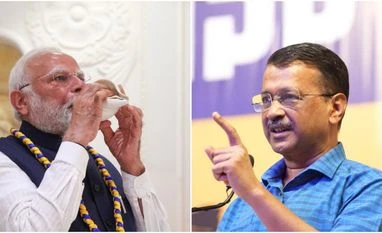
While AAP had a clear CM face in
Arvind Kejriwal, BJP relied solely on Prime Minister
Narendra Modi’s towering influence. Despite lacking a projected CM candidate, BJP’s campaign focused on PM Modi’s appeal, which outshone Kejriwal’s image—tarnished by corruption scandals and the Sheesh Mahal controversy.
PM Modi’s direct appeal to Delhi voters for a double-engine government—one that would align with the Centre to accelerate development—resonated deeply. The anti-incumbency against Kejriwal was evident, and BJP capitalised on it by running a hyper-local, constituency-specific campaign.

 "How BJP ended AAP's 10-year rule and took back Delhi after 27 years")


