Bangladesh drops Sheikh Mujib from currency, adds temples, landmarks
Bangladesh unveils new currency notes without Sheikh Mujibur Rahman's image, featuring Hindu and Buddhist temples, landmarks, and artwork instead, amid major political and leadership changes
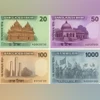
The redesigned notes, released on Sunday (June 1), now feature motifs of Hindu and Buddhist temples, traditional landmarks, and celebrated national artwork. | Credit: X@RawMindset1
For the first time in more than five decades, the image of Sheikh Mujibur Rahman, the founding father of Bangladesh, has been removed from new banknotes. The redesigned notes, released on Sunday (June 1), now feature motifs of Hindu and Buddhist temples, traditional landmarks, and celebrated national artwork — signalling a significant symbolic shift in the country’s political and cultural narrative.
Sheikh Mujibur Rahman, the first President and former Prime Minister of Bangladesh, had appeared on every banknote since the nation’s birth in 1971. However, with the ouster of his daughter and former Prime Minister Sheikh Hasina last year, the interim government led by Nobel Laureate Muhammad Yunus had announced a phased revamp of the country’s currency, aimed at removing political iconography.
No human portraits in new currency design
According to Bangladesh Bank, the newly issued notes — Tk 1000, Tk 50, and Tk 20 — do not carry any human portraits. Instead, they celebrate Bangladesh’s cultural heritage and natural beauty.
“Under the new series and design, the notes will not feature any human portraits, but will instead showcase natural landscapes and traditional landmarks,” said Bangladesh Bank spokesman Arif Hossain Khan in a statement to AFP.
He added, “The new notes will be issued from the central bank’s headquarters, and later from its other offices across the country. The other denominations of the notes with new designs will be released in phases.”
The new designs include depictions of Hindu and Buddhist temples, artwork by the late Zainul Abedin, and the National Martyrs’ Memorial, which commemorates those who died in the 1971 liberation war against Pakistan.
Political backdrop: Hasina indicted for mass murder
The currency redesign comes at a politically charged time. On the same day the new notes were unveiled, Bangladesh’s International Crimes Tribunal formally indicted Sheikh Hasina in absentia for her role in the deadly 2024 crackdown on student-led protests. Prosecutors accused the former prime minister of “exercising absolute authority to ruthlessly suppress the uprising”, levelling mass murder charges and issuing a fresh arrest warrant against Hasina and then Home Minister Asaduzzaman Khan Kamal.
Hasina fled to India in August last year after weeks of nationwide unrest, ending her 15-year rule. Since then, the country has been governed by a caretaker administration headed by Muhammad Yunus. In May, the Awami League — Hasina’s party — was banned pending the outcome of the trials.
A currency shaped by politics
This is not the first time Bangladesh’s currency has changed in response to political shifts. In 1972, the newly independent country issued notes featuring a map of Bangladesh after gaining freedom from Pakistan. Later, under the rule of the Awami League, notes prominently featured Sheikh Mujibur Rahman.
During the rule of the Bangladesh Nationalist Party (BNP) and its leader Khaleda Zia, the currency showcased archaeological and historical sites instead of political figures.
With the current transition, the new banknotes reflect the Yunus-led administration’s stated aim to promote inclusivity and national heritage over political legacy. However, the co-existence of old and new notes — both now in legal circulation — marks a period of visual and ideological overlap in Bangladesh’s evolving identity.

 "Bangladesh drops Sheikh Mujib from currency, adds temples, landmarks")


