External Affairs Minister S Jaishankar on Wednesday (India time) called for an urgent resolution to conflicts — including the Russia-Ukraine war — which are impacting food, fertiliser, and energy security.
He bemoaned the fact that the “very concept of multilateralism is under attack” with international organisations having been rendered ineffective or starved of resources.
“The building blocks of the contemporary order are starting to come apart. And the cost of delaying much-needed reforms is today starkly visible,” he said.
Also, in his address at the “high-level” meeting of “Like-Minded Global South Countries”, on the sidelines of the 80th session of the United Nations General Assembly (UNGA) in New York, the minister stressed the need for countries of the Global South to develop resilient, reliable, and shorter supply chains that would reduce dependence on any single supplier or any single market.
Jaishankar’s comments come in the context of the White House having imposed high tariffs on Indian goods, including a 25 per cent penalty for India’s purchase of Russian oil.
New Delhi also faces an uncertain supply of critical minerals and fertilisers from China.
Over the past few months, India has explored diversifying its export markets, and also looked for alternative sources to procure rare-earth minerals, for which it has been heavily dependent on China. The Russia-Ukraine war has disrupted India’s fertiliser import.
Jaishankar sought unity among the countries of the Global South to work on creating a stable environment for balanced and sustainable economic interactions, including more South-South trade, investment, and technology collaborations and fair and transparent economic practices that democratise production and enhance economic security.
Jaishankar spoke of the world living in “increasingly uncertain times” at least since 2020. He said the Global South had been confronted with the “shocks” of the pandemic, two major conflicts in Ukraine and Gaza, extreme climate events, volatility in trade, uncertainty in investment flows and interest rates.
On the sidelines of the UNGA session, Jaishankar attended an informal meeting of European Union (EU) foreign ministers, hosted by EU High Representative for Foreign Affairs and Security Policy Kaja Kallas.
Several EU members have disagreed with the US singling out India in imposing some of the highest tariffs. In an interview to Bloomberg, Finnish President Alexander Stubb said the West shouldn’t put India “in the same basket as Russia or China”, and it is “very important for the West” to engage with India.
In his interview with Fox News, Ukrainian President Volodymyr Zelenskyy said that India was “mostly with us”.
“Yes, we have these questions with energy, but I think that President Trump can manage it with Europeans, make more close and strong relations with India,” Zelenskyy said. “And I think, we have to do everything not to withdraw Indians and they will change their attitude to the Russian energy sector,” he said.
In an interview with a media outlet, United States (US) Secretary of State Marco Rubio described India as a very close partner of the US.
Rubio on Monday met Jaishankar. In another interview, Rubio repeated that President Donald Trump resolved the India-Pakistan conflict.
On Tuesday evening, in his address at the UNGA, Trump claimed that he has ended “seven unendable wars”. India has maintained that there was no third-party intervention in its ceasing hostilities with Pakistan on May 10.
In New York, Jaishankar also met his counterparts from the Netherlands, Denmark, Singapore, Jamaica, Mauritius, and others.
He also met Sultan Ahmed Bin Sulayem, group chairman and chief executive officer, DP World, a Dubai-based multinational logistics company.

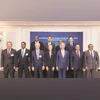 "Global South mustn't rely on single market, says EAM S Jaishankar")



