
Farmers rush to wrap up harvest near J-K's IB amid rising tension with Pak
While over 90 percent of the wheat and other crops have been harvested, the process of harvesting the rest, packaging them and sending them to mills remains
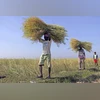 "Farmers rush to wrap up harvest near J-K's IB amid rising tension with Pak")
Explore Business Standard

Associate Sponsors
Co-sponsor
While over 90 percent of the wheat and other crops have been harvested, the process of harvesting the rest, packaging them and sending them to mills remains
Farmers living along the nearly 200-km-long International Border in Jammu and Kashmir are racing against time to complete the harvest process amid heightened tension following the Pahalgam terror attack.
In the three districts of Jammu, Samba, and Kathua, about 1.25 lakh hectares of agricultural land falls within the shelling range of Pakistan.
Villages like Treva, Mahashe-de-Kothe, Chandu Chak, Gharana, Bulla Chak, and Korotana Kalan are witnessing a flurry of activity, with families working day and night to finish harvesting, dry the grain, and pack it for delivery to mills.
While over 90 percent of the wheat and other crops have been harvested, the process of harvesting the rest, packaging them and sending them to mills remains.
We are racing against time to complete harvesting, Santosh Singh, a 50-year farmer from Treva village in the Arnia sector said, adding there is very little time left.
Treva, located just 1.5 km from the border, is directly under threat from Pakistan Rangers.
Since the April 22 Pahalgam attack that left 26 people dead, the farming community in Treva is anxious and authorities have responded with urgency.
"An alert has been sounded. The tehsildar has arranged 20 harvesters to speed up the harvesting process. Ninety-five percent of the harvesting has already been completed in these belts, another farmer from Treva, Rakesh Kumar told PTI here.
We live in a danger zone. Every time shelling starts, we face death and destruction", he said.
Radhika Devi, who belongs to a farmers' family of village Suchetgarh, said her family had packed over 300 bags of wheat in just a few days.
It is an emergency. Mill owners are paying well and are quickly ferrying the bags to safer areas.
Tarika Devi of Korotana Kalan echoed the urgency. We were alerted after the Pahalgam massacre. Now that most of the harvesting is over in our belt, we are rushing to stock the produce. Shelling could resume at any time.
Amid the heightened tension, finding labour has become a challenge.
Labourers from Bihar and Uttar Pradesh, who usually help us during harvesting, have refused to work in the fields under these hostile conditions, Kuldeep Kumar, a farmer from Suchetgarh, said.
The agricultural stretch from Paharpur in Kathua district bordering Punjab to Chicken's Neck in Jammu district remains vulnerable, with thousands of families living within five km of the border constantly under threat.
Chandu Chak village farmer Sardar Teg Singh said, The fear is constant, but we have become used to it. This time, we are better prepared. Not only can we save our lives and livestock, but we are also managing to save our cropssomething we couldn't always do in the past.
According to the Basmati Rice Growers Association (BRGA) of R S Pura, nearly 1 to 1.25 lakh hectares of land, mostly known for world-class Basmati rice, is routinely impacted by cross-border shelling.
Although India and Pakistan agreed to a renewed ceasefire in February 2021, the fragile peace has come under fresh strain after the Pahalgam terror strike.
The fear gripping border residents today is reminiscent of the 2021 period, when intense shelling forced mass evacuations and destruction of property and cattle from areas along the IB.
"We feel it would be worse than the 2021 shelling and firing. It is likely to be war, which we witnessed in 1971. We are better prepared this time. We will fully support our troops bravely from our villages", 80-year-old Faqir Chand of Mahashe-de-Kothe village said.
For the farmers of Jammu's border belt, the harvest season, usually marked by celebration and relief, is now one of anxiety, urgency, and survival.
(Only the headline and picture of this report may have been reworked by the Business Standard staff; the rest of the content is auto-generated from a syndicated feed.)
First Published: May 06 2025 | 12:20 PM IST

