Associate Sponsors

Co-sponsor

IAF to have free hand to integrate weapons on 114 new Rafales: Sources

Additional Rafales to be of a vastly improved standard over 2016 jets
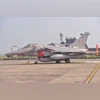
rafale, defence, air force
According to Dassault, the future Rafale F5 jets will feature capabilities that will allow them to remain operational beyond 2060 and will be optimised to operate alongside unmanned combat aircraft.
Bhaswar Kumar
4 min read Last Updated : Feb 06 2026 | 10:07 PM IST
The Indian Air Force (IAF) will have full “unilateral” authority to integrate weapons of its choice — including Made in India munitions — on board the additional 114 Rafale combat aircraft that India is actively considering purchasing from French aerospace major Dassault Aviation, defence sources told Business Standard on Friday. They added that the final deal would be cost-competitive by international standards, despite incorporating a significant push for local manufacturing and maintenance.
 
“The additional Rafales will be from a vastly improved version compared to the 36 acquired for the IAF under the 2016 deal,” one of the sources added. The new jets will be of the latest “F4 standard” and are planned to be upgraded to the under-development “F5 standard” in due course. According to Dassault, the future Rafale F5 jets will feature capabilities that will allow them to remain operational beyond 2060 and will be optimised to operate alongside unmanned combat aircraft.
 
The Indian Navy has also placed orders for 26 marine variants of the aircraft.
 
“We will have unilateral capability, meaning a free hand, to integrate weapons on board the additional jets. This will be part of the negotiations,” said one of the sources, on condition of anonymity, adding that this would allow indigenous munitions — such as the Astra beyond-visual-range air-to-air missile — to be integrated on board the French jets.
 
Integrating indigenous weapons could also eventually reduce costs for the user, as the weapons package forms a significant part of an aircraft’s overall price. It would also allow the service to tailor the aircraft’s offensive capabilities to its evolving requirements.
 
Dispelling a common misconception, the sources also said this would not require access to the aircraft’s “source code” — the software backbone that governs its sensors, weapons and mission systems.
 
They added that another key element of the negotiations would be ensuring that the software-defined radio (SDR) on board the jets is capable of faster “cross-talk” — enabling what is known in military parlance as net-centric operations — with all current and future IAF platforms, regardless of origin. While the IAF’s existing fleet, comprising largely Russian- and Western-origin jets alongside indigenous platforms, is already capable of net-centric operations, the additional Rafales would do so more quickly and efficiently.
 
An SDR is a flexible, programmable communication system that enables aircraft to securely share data across networks. This supports net-centric air warfare, linking sensors, shooters and command systems in real time, and ultimately enables collaborative engagement, where multiple platforms jointly detect, track and engage targets using shared information. This approach to operations has become a necessity on today’s battlefield.
 
Though commercial negotiations have yet to begin, the sources said preliminary estimates suggest the per-unit cost of the jets will be lower than in deals signed by countries such as Germany, Italy and Turkey for similarly capable aircraft. “The latest 4.5-generation aircraft, including their weapons package, cost upwards of $240 million per unit. We are aiming for a lower figure, even after accounting for significant indigenous content through local manufacturing and localised maintenance, repair and overhaul,” one of them said. “We will pursue tough negotiations from our end,” they added.
 
In January, the Ministry of Defence’s Defence Procurement Board accorded its recommendation to the proposal to acquire 114 Rafale jets. The proposal is now likely to be considered by the Defence Acquisition Council, headed by Defence Minister Rajnath Singh, next week. If it secures this initial nod, the technical and commercial negotiations will commence. Ultimately, it will be taken up for final approval by the Cabinet Committee on Security, chaired by Prime Minister Narendra Modi.
 
Once the deal goes through, the jets will be procured under a ‘Make in India’ framework, with Dassault partnering an Indian firm. The agreement is expected to include transfer of technology, with indigenous content in the aircraft eventually rising to between 55 per cent and 60 per cent.

One subscription. Two world-class reads.

Already subscribed? Log in

Subscribe to read the full story →
*Subscribe to Business Standard digital and get complimentary access to The New York Times

Smart Quarterly

₹900

3 Months

₹300/Month

SAVE 25%

Smart Essential

₹2,700

1 Year

₹225/Month

SAVE 46%
*Complimentary New York Times access for the 2nd year will be given after 12 months

Super Saver

₹3,900

2 Years

₹162/Month

Subscribe

Renews automatically, cancel anytime

Here’s what’s included in our digital subscription plans

Exclusive premium stories online

  • Over 30 premium stories daily, handpicked by our editors

Complimentary Access to The New York Times

  • News, Games, Cooking, Audio, Wirecutter & The Athletic

Business Standard Epaper

  • Digital replica of our daily newspaper — with options to read, save, and share

Curated Newsletters

  • Insights on markets, finance, politics, tech, and more delivered to your inbox

Market Analysis & Investment Insights

  • In-depth market analysis & insights with access to The Smart Investor

Archives

  • Repository of articles and publications dating back to 1997

Ad-free Reading

  • Uninterrupted reading experience with no advertisements

Seamless Access Across All Devices

  • Access Business Standard across devices — mobile, tablet, or PC, via web or app

Topics :Indian Air ForceRafale deal India weapons

Next Story


