Seldom in the last couple of decades — at least not since it shed its inhibitions over engaging with the United States — has India pursued a multipolar outreach to the rest of the world with as much vigour as it has since June this year.
In the last four months, as it pressed its strategic autonomy, India has restored its proximity with old ally Russia, that too in the face of US pressure. It has attempted to consolidate a thaw in ties with Beijing, but also proactively engaged with the island-nations of the Indo-Pacific with a shared concern about Chinese muscle-flexing in the region.
Alongside, New Delhi has sought to diversify both its export markets and its supply chains to take on the twin challenges of American tariffs on its exports, and Chinese restrictions on Indian imports of rare earth elements and fertilisers. It has scouted for opportunities in Africa and Latin America for both.
South Block’s efforts to recalibrate its foreign policy were triggered initially by an effort to put forth its perspective on Operation Sindoor against Pakistan in the aftermath of the April 22 Pahalgam terrorist attack. The task became more urgent when US President Donald Trump imposed tariffs on Indian goods in May, and doubled them in August.
The Trump administration has since taken several other steps that have surprised New Delhi, such as hosting the Pakistani army chief at the White House, and increasing the fee for new H1B visas to $100,000. Former foreign secretary Nirupama Rao, who has served as India’s ambassador to the US, told the US-India Strategic Partnership Forum that US-India ties would weather the current storm as the foundation remains strong.
Pat on the back
South Block believes it could pat itself on the back for its hard work in the last four months. India has “reset” its fractured ties with Canada after an acrimonious 2023-24, with Prime Minister Narendra Modi visiting the country in June. The national security advisers of the two countries met recently and the respective diplomatic presence in each other’s capitals is being restored.
Since June, India has inked a free trade agreement (FTA) with the UK when the PM visited London on July 24. His British counterpart, Keir Starmer, is slated to visit Mumbai and Bengaluru from October 7 to 9. While talks for the India-US Bilateral Trade Agreement remain in a limbo, New Delhi is in advanced negotiations to sign trade agreements with the Eurasian Economic Union – comprising Armenia, Belarus, Kazakhstan, Kyrgyzstan, and Russia – as well as the 27-nation European Union (EU).
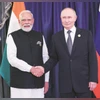
Ties with Moscow could see further highs when Russian President Vladimir Putin visits India in December. The Russians are keen to supply fertilisers, and buy some of the shrimps that Andhra Pradesh produces.
Swedish Ambassador to India Jan Thesleff told Business Standard earlier this month that the Nordic countries are keen to host Modi by the end of the year for the India-Nordic Summit, which had to be postponed in May because of the outbreak of India-Pakistan hostilities.
Alongside, Finnish President Alexander Stubb has urged the US to not put India in the same basket as Russia and China.
The EU leadership has sent delegations and called Modi frequently in the last few weeks to restate their support for an India-EU FTA at the earliest. An India-EU Summit is likely next year, and French President Emmanuel Macron is also slated for an India visit in February.
Indo-Pacific focus
The thaw with China on the border and trade issues notwithstanding, New Delhi has also been mindful of the security challenges in the Indo-Pacific. The Prime Ministers of Mauritius and Singapore visited India in September, as did the Prime Minister of Fiji and President of the Philippines in August, while Modi visited the Maldives in July. They discussed increasing trade, but also deepening maritime security and defence cooperation.
On his way to the northern Chinese city of Tianjin to attend the Shanghai Cooperation Organisation Summit, PM Modi was mindful of the concerns of Tokyo, a close ally of New Delhi over the years. He visited Japan on August 30 before he landed in China.
In the first week of July, Modi was out of India for a rare eight straight days, visiting five countries spread across three continents, some of which an Indian PM had not been to in decades. At least four of the five could help India meet its growing need for critical minerals. It was his longest foreign visit in terms of distance covered, and the second longest in terms of days since July 2015, when he visited six countries over eight days, including Russia, and the five Central Asian countries.
Between July 2 and 9 this year, Modi visited Ghana, the first by an Indian PM in 30 years, Namibia (the first in 27 years), Argentina, the first since Indira Gandhi in 1968, and also Brazil, Trinidad, and Tobago.
Prime Minister Narendra Modi with his Japanese counterpart Shigeru Ishiba; FM Nirmala Sitharaman with Singapore PM Lawrence Wong; Modi with Brazil’s President Luiz Inácio Lula da Silva; Foreign Secretary VikramMisri with Mauritius PM Navinchandra Ram
Reverse flow
There have also been several important visits to India in the last four months. The German foreign minister was in India in September, as was Singapore’s. Chinese Foreign Minister Wang Yi visited India on August 18-19 to discuss the boundary dispute. Delegations from Latin America, France, and the EU have also been to India. Meanwhile, Indian officials have concluded trilateral consultations with Armenia and Iran in Tehran.
In the context of the Indian skilled workers finding it hard to work in the US, Japan, Singapore, Sweden, Germany and other European countries are keen to host Indian skilled talent.
For example, Indians form the largest number of students in Sweden, Swedish diplomats said. As many as 8,800 Indian students applied to study in Sweden last year. According to India’s external affairs ministry, there are 88,400 people of Indian origin in Sweden, of which 66,400 are Indian nationals. Most of them are professionals, predominantly in the IT sector.
It is evident from the last few months that New Delhi will continue to engage with the US. But it now knows that the ‘exception-ism’ with which Washington treated it is over. It knows, too, that it needs to focus on new markets for its exports, find new allies in Europe and Indo-Pacific, nourish its “time-tested” ties with Russia, shape its strategic autonomy, and contribute to not just a multipolar world, but also a multipolar Asia.