With both India and China facing the economic fallout from the US trade war, Prime Minister (PM) Narendra Modi and Chinese President Xi Jinping on Sunday agreed that their countries’ economies could help stabilise world trade. They also underlined the need to approach bilateral trade and investment ties from a political and strategic perspective to reduce the trade deficit.
At their second meeting in less than a year, on the margins of the Shanghai Cooperation Organisation (SCO) Summit in the northern Chinese city of Tianjin, Xi told Modi that achieving a “dragon-elephant dance” is the right choice for the two neighbours.
Modi said maintaining peace and tranquillity at the border is like an insurance policy for India-China ties. However, Xi emphasised that China-India relations should not be defined merely by the boundary issue.
Modi added, with Xi agreeing, that India and China are partners, not adversaries, with far more consensus than differences. The two leaders agreed that their differences should not turn into disputes. Later, in an evening briefing to the media, India’s Foreign Secretary Vikram Misri alluded to the tariff war unleashed by Washington, observing that the two leaders recognised the situation and saw potential to “leverage” it to build greater understanding between the countries, especially to advance commercial ties.
They affirmed that a stable and amicable India-China relationship can benefit the 2.8 billion people of the two countries. The PM also said that the two countries will soon resume direct flights, with officials noting that only operational issues need to be resolved.
The Indian side also stressed the need for greater transparency and predictability in trade and related policies, saying that narrowing the trade deficit could change perceptions in the relationship.
Modi and Xi had last met in Kazan, Russia, on the sidelines of the Brics summit. Their meeting had thawed India-China relations after four years of tension following the border clashes in eastern Ladakh in June 2020. This is the PM’s first visit to China in seven years.
At their Sunday meeting, Xi suggested four steps to further strengthen ties: bolstering strategic communication and deepening mutual trust; expanding exchanges and cooperation to achieve mutual benefit and win-win results; accommodating each other’s concerns; and strengthening multilateral cooperation to safeguard common interests.
Both leaders agreed that the two countries should handle their relations as partners rather than adversaries, and as opportunities rather than threats. With the SCO emerging as a key grouping in the context of the US-imposed tariff war, Xi stressed the need for India and China to uphold multilateralism, enhance coordination on major international and regional issues, and defend international fairness and justice.
Modi said India and China both pursue strategic autonomy, and their relations should not be viewed through the lens of a third country. The two leaders deemed it necessary to expand common ground on bilateral, regional, and global issues and challenges, such as terrorism and fair trade on multilateral platforms. The PM also met Cai Qi, member of Standing Committee of the Politburo of the Communist Party of China, seeking his support for better India-China ties.
Speaking at the welcome banquet, Xi said that given the international situation and the gathering of top leaders from key countries — including Russian President Vladimir Putin, Modi, and Iranian President Masoud Pezeshkian — the SCO now bears “greater responsibility” for safeguarding regional peace and stability, as well as promoting the development and prosperity of its member states.
Xi and Putin had skipped the Brics meeting in Brazil held in July, but are present here, making the SCO in Tianjin not just the biggest event on China’s diplomatic calendar this year but also a Beijing-led bloc that aims to offer an alternative to the US-led world order.
Modi and Xi welcomed the positive momentum and steady progress in bilateral relations since their last meeting in Kazan in October 2024. The Indian side highlighted the trade deficit New Delhi has with Beijing. India’s trade deficit with China rose from $1.1 billion in 2003-04 to $99.2 billion in 2024-25. China’s share accounted for about 35 per cent of India’s total trade imbalance ($283 billion) in the last financial year, up from $85.1 billion in 2023-24.
Xi said that the international situation is both fluid and chaotic. “We must also step up our historic responsibility to uphold multilateralism, work together to bring about a multipolar world and more democracy in international relations, and make our due contributions to peace and prosperity in Asia and around the world,” he said.
Modi also invited Xi to visit India for the Brics summit next year.

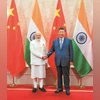 "PM Modi and Xi Jinping vow to stabilise world trade, boost investment ties")


