
Pakistan army chief Gen Munir reiterates two-nation theory at parade
On Saturday, Munir was addressing the passing out parade of cadets at the Pakistan Military Academy (PMA) in Kakul area of Khyber-Pakhtunkhwa province
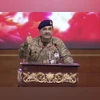 "Pakistan army chief Gen Munir reiterates two-nation theory at parade")
Explore Business Standard

Associate Sponsors
Co-sponsor
On Saturday, Munir was addressing the passing out parade of cadets at the Pakistan Military Academy (PMA) in Kakul area of Khyber-Pakhtunkhwa province
Pakistan army chief General Asim Munir on Saturday highlighted the two-nation theory', stating that Muslims and Hindus are two different nations.
Munir's remarks came almost a week after he had described Kashmir as Pakistan's jugular vein during a diaspora event and asked overseas Pakistanis to pass on the country's story to their children, emphasising that their forefathers believed Hindus and Muslims were different in every possible aspect of life.
On Saturday, Munir was addressing the passing out parade of cadets at the Pakistan Military Academy (PMA) in Kakul area of Khyber-Pakhtunkhwa province.
The two-nation theory was based on the fundamental belief that Muslims and Hindus are two separate nations, not one. Muslims are distinct from Hindus in all aspects of life religion, customs, traditions, thinking and aspirations, Munir said.
His remarks come amidst tension with India in the wake of the Pahalgam terrorist attack on Tuesday which killed 26 people and prompted India to announce several measures against Pakistan, including the suspension of the Indus Water Treaty.
Undeterred by the unfolding security situation, Gen Munir said that Pakistan was achieved after many sacrifices and it was the duty of the armed forces to keep it safe. Our forefathers made immense sacrifices for the creation of Pakistan. We know how to defend it.
Earlier on April 16, while addressing a Convention for Overseas Pakistanis in Islamabad, Munir claimed that Hindus and Muslims are different nations, and urged the audience to tell the story of creation of Pakistan to their children.
You have to tell Pakistan's story to your children so that they don't forget that our forefathers thought we were different from Hindus in every possible aspect of life, he said, evoking the two-nation theory propagated by Pakistan's founder M A Jinnah.
Our religions are different, our customs are different, our traditions are different, our thoughts are different, our ambitions are different. That was the foundation of the two-nation theory that was laid there. We are two nations, we are not one nation, he added.
Prior to it, in the same address, speaking about Kashmir, he had said: Our stance is very clear, it was our jugular vein, it will be our jugular vein, and we will not forget it. We will not leave our Kashmiri brothers in their heroic struggle.
India has repeatedly told Pakistan that the Union Territories of Jammu & Kashmir and Ladakh was, is and shall forever remain an integral part of the country.
The ties between the two countries nosedived after India abrogated Article 370 of the Constitution, revoking the special status of Jammu and Kashmir, and bifurcating the State into two Union Territories on August 5, 2019.
(Only the headline and picture of this report may have been reworked by the Business Standard staff; the rest of the content is auto-generated from a syndicated feed.)
First Published: Apr 26 2025 | 5:50 PM IST

