
Govt adopted pro-poor approach in GST implementation: FM Sitharaman
"This demonstrates that the Centre & States, collectively, through better tax administration, are able to collect the same revenue with a lower burden on our taxpayers," she said
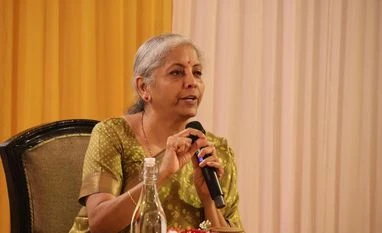 "Govt adopted pro-poor approach in GST implementation: FM Sitharaman")
WebinarsNew
Deep DiveNew
Explore Business Standard
"This demonstrates that the Centre & States, collectively, through better tax administration, are able to collect the same revenue with a lower burden on our taxpayers," she said
Finance Minister Nirmala Sitharaman on Monday said the government has adopted "a pro-poor approach" while implementing Goods and Services Tax, and despite lower taxes rates the revenues as a percentage of GDP have reached the pre-GST level.
In a post on X (formerly Twitter), Sitharaman said without GST, states' revenue from subsumed taxes from FY 2018-19 to 2023-24 would have been Rs 37.5 lakh crore. With GST, states' actual revenue amounted to Rs 46.56 lakh crore.
"Despite the GST rate being less than the prescribed Revenue Neutral Rate and COVID-19 affecting the revenues, GST collections (as a percentage of GDP) have now reached the levels they were before GST (both net and gross).
"This demonstrates that the Centre & States, collectively, through better tax administration, are able to collect the same revenue with a lower burden on our taxpayers," she said.
GST, which was rolled out on July 1, 2017, had subsumed 17 taxes and 13 cesses into a 5-tier structure, thereby simplifying the tax regime. The turnover threshold for registration rose to Rs 40 lakh for goods and Rs 20 lakh for services (from Rs 5 lakh on average under VAT). GST also reduced 495 different submissions (challan, forms, declarations, etc) across states to just 12.
Sitharaman in a detailed post on GST talked about the origin of GST and its role in streamlining the indirect tax system. She also penned down how GST has benefitted people through a pro-poor approach, while underscoring its role in promoting cooperative and fiscal federalism.
The minister said GST has improved tax buoyancy from 0.72 (pre-GST) to 1.22 (2018-23). Despite compensation ending, state revenues remain buoyant at 1.15, she said.
"Reflecting a pro-poor approach, the effective weighted average GST rate has consistently fallen since 2017. The Revenue Neutral Rate was suggested to be 15.3 per cent but was lower at 14.4 per cent in 2017, and it has come down to 11.6 per cent in 2019," she said.
Sitharaman said the idea of GST was first mooted during the former Prime Minister Atal Bihari Vajpayee-led NDA government.
In 10 years, UPA was unable to achieve political consensus on GST, she said, adding, "under the leadership of Prime Minister Narendra Modi, the necessary consensus was carefully built, and GST Acts were passed by Parliament in 2016".
GST revenues have touched a record high of Rs 2.10 lakh crore in April buoyed by domestic transactions, the minister said.
Sitharaman on Monday administered the oath of office to Justice (Retd) Sanjaya Kumar Mishra as first President of the GST Appellate Tribunal (GSTAT) -- body for resolving disputes.
Sitharaman said GST lowered taxes on many essential items compared to pre-GST rates. Common items like hair oil and soaps saw tax cut from 28 per cent to 18 per cent.
Electrical appliances taxed at 12 per cent versus 31.5 per cent before. Movie tickets were taxed lower, too. Further tax rate rationalization has been done since 2017. National Anti-profiteering Authority ensured that companies passed the benefits to the consumers.
GST has exempted many essential items and services, such as unbranded food items, certain life-saving drugs, healthcare, education, public transport, sanitary napkins, hearing aid parts, agricultural services, etc, she said.
On the apprehension that Centre is cornering all GST revenue, Sitharaman said, "it is a myth that all GST collections are pocketed by the Centre".
GST contributes significantly to state revenues -- States receive 100 per cent of SGST collected in that state, approximately 50 per cent of IGST (i.e. on inter-state trade). A significant portion of CGST, i.e., 42 per cent, is devolved to the states based on the Finance Commission's recommendations, she added.
(Only the headline and picture of this report may have been reworked by the Business Standard staff; the rest of the content is auto-generated from a syndicated feed.)
First Published: May 06 2024 | 8:31 PM IST


 Connect with us on WhatsApp