Debates over 167 days, 274 members, 36 lakh words -- that's what it took before the Constituent Assembly adopted the world's longest written constitution on this day in 1949.
Every Article in the Constitution, which ran into 145,000 words at the time, was debated by members of the Constituent Assembly. They sat for 11 sessions and 167 days over a period of two years, 11 months and 18 days to frame the Constitution.
BR Ambedkar, regarded as the chief architect of the Constitution, was assisted by members of the drafting committee he chaired.
India's first president Rajendra Prasad was the first person to sign the document 75 years ago.
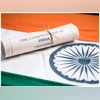
It is the largest written constitution in the world and the first edition was neither printed nor typed -- it was handwritten and calligraphed in both Hindi and English.
According to facts available on the Lok Sabha website and analysis of Constituent Assembly debates by the think-tank PRS India, the Constitution's first copy was handwritten by Prem Behari Narain Raizada and published by him in Dehradun.
Every page was decorated by artists from Shantiniketan, including Beohar Rammanohar Sinha and Nandalal Bose.
It took two years, 11 months and 18 days to complete the final draft. At present, it contains 395 Articles and 12 Schedules. The Constitution has been amended 106 times so far.
Approximately 36 lakh words were spoken during debates in the Constituent Assembly and two-thirds of all deliberations were during the clause-by-clause discussions during the second reading.
From November 1948 to October 1949, the Constituent Assembly met for clause-by-clause discussions on the draft Constitution. The members met for 101 days during this period.
Fundamental Rights were included in Part III of the draft Constitution and discussed for 16 days.
As much as 14 per cent of the total clause-by-clause discussions was dedicated to Fundamental Rights.
Directive Principles of State Policy were included in Part IV and discussed for six days.
Four per cent of the clause-by-clause discussion was dedicated to Directive Principles.
Provisions related to citizenship were included in Part II. Two per cent of the discussion was dedicated to this part.
Six members spoke more than a lakh words, with Ambedkar contributing over 267,000 words.
India's first prime minister Jawaharlal Nehru, a member of the Constituent Assembly, spoke 73,804 words.
The drafting committee scrutinised and revised the draft created by BN Rau, the constitutional advisor, and submitted it for consideration of the assembly.
The drafting committee members frequently responded to comments made by other members during the discussion.
A few members who were not part of the drafting committee participated extensively in Constituent Assembly debates. Five such members said more than a lakh words each.
Fifteen women were a part of the Constituent Assembly during its entire tenure. Of them, 10 participated in debates and contributed to two per cent of the discussions.
The highest participation was made by G Durgabai with nearly 23,000 words. She spoke extensively on the judiciary during the debates.
Ammu Swaminathan, Begum Aizaz Rasul and Dakshyani Velayudhan participated in debates on Fundamental Rights.
Hansa Mehta and Renuka Ray participated in debates on justice for women.
Interestingly, members from provinces contributed 85 per cent to the Constituent Assembly debates.
In the Constituent Assembly, 210 members elected from provinces and 64 members nominated by the princely states participated in debates.
On an average, each member from the provinces spoke 14,817 words and a member from the princely states spoke 3,367 words.
Speeches and interventions made by presiding officers contributed to nine per cent of the discussions.
The Constituent Assembly met for the first time in Delhi on December 9, 1946, in the Constitution Hall, now known as the Central Hall of old Parliament House -- called Samvidhan Sadan.
Decorated elegantly for the occasion on the day, the chamber wore a new look with a constellation of bright lamps hanging from the high ceilings and from brackets on its walls.
The members sat in semi-circular rows facing the presidential dais. Desks that could be electrically warmed were placed on sloping green-carpeted terraces.
Those who sat in the front row were Nehru, Maulana Abul Kalam Azad, Sardar Vallabhbhai Patel, Acharya JB Kripalani, Prasad, Sarojini Naidu, Hare-Krushna Mahatab, Govind Ballabh Pant, Ambedkar, Sarat Chandra Bose, C Rajagopalachari and M Asaf Ali.
Two hundred and seven representatives, including nine women, were also present.


 "Constitution Day 2024: Epic story behind the drafting of India's charter")


