
Delhi records coldest December morning in 3 yrs as temp drops to 4.5C
The city recorded a low of 4.5 degrees Celsius on Thursday, 0.4 degrees below normal, compared to 4.9 degrees Celsius on Wednesday, the India Meteorological Department (IMD) said
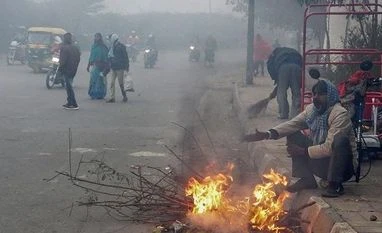 "Delhi records coldest December morning in 3 yrs as temp drops to 4.5C")
Explore Business Standard
The city recorded a low of 4.5 degrees Celsius on Thursday, 0.4 degrees below normal, compared to 4.9 degrees Celsius on Wednesday, the India Meteorological Department (IMD) said
The city recorded its coldest December day in the last three years on Thursday as the minimum temperature dropped to 4.5 degrees Celsius.
The forecast predicts cold wave conditions to persist at isolated places until the weekend.
The city recorded a low of 4.5 degrees Celsius on Thursday, 0.4 degrees below normal, compared to 4.9 degrees Celsius on Wednesday, the India Meteorological Department (IMD) said.
The temperature had dropped sharply from 5 degrees Celsius on Wednesday.
According to data, the minimum temperature did not drop below 4.9 degrees Celsius in December 2023 and 2022.
The lowest minimum temperature recorded in December last year was 4.9 degrees Celsius on the 15th, while the lowest in 2022 was 5 degrees Celsius on the 26th.
Cold wave conditions were observed at isolated places in Delhi, including Ayanagar and Pusa, where the temperatures dropped to 3.8 and 3.2 degrees Celsius respectively.
According to the India Meteorological Department, cold wave conditions occur when actual temperatures fall below 4.1 degrees Celsius or when the departure from normal is 4.4 degrees Celsius or more below average.
Meanwhile, the maximum temperature during the day was recorded at 22.2 degrees Celsius, 0.8 degrees below normal, the IMD said.
The humidity fluctuated between 88 per cent and 52 per cent during the day.
The weather department has forecast cold wave conditions at isolated places until December 15.
Smog and mist are likely on Friday morning, with a mainly clear sky during the day. Smog and mist are expected again in the evening and night.
Delhi's air quality remained in the poor category, with a 24-hour average AQI of 288.
Out of 38 monitoring stations, 20 recorded AQI in the very poor category, while the remaining stations reported air quality in the poor category, according to data from the Sameer app.
The Central Pollution Control Board (CPCB) classifies AQI between 0 and 50 as good, between 51 and 100 as satisfactory, between 101 and 200 as moderate, between 201 and 300 as poor, between 301 and 400 as very poor, and above 400 as severe.
(Only the headline and picture of this report may have been reworked by the Business Standard staff; the rest of the content is auto-generated from a syndicated feed.)
First Published: Dec 12 2024 | 9:10 PM IST


