Federation is a Union because it is indestructible: SG Mehta on Article 370
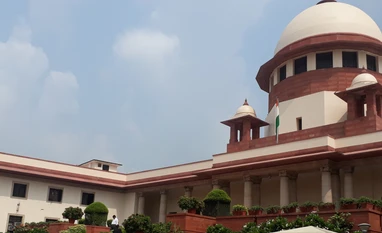
A 5-judge bench headed by CJI DY Chandrachud was hearing a batch of petitions challenging the abrogation of Article 370 that accorded special status to the erstwhile state of Jammu and Kashmir
BS Web Team New Delhi Speaking in the Supreme Court (SC) on the
Article 370 abrogation case, solicitor-general Tushar Mehta said that the drafting committee wanted to make it clear that though India was a federation, the federation was not a result of an agreement by the states.
According to LiveLaw, he added that thus, no state had the right to secede from it.
"The federation is a Union because it is indestructible," he added.
On Wednesday, the apex court said there is "intrinsic evidence" that Article 370 has a "self-limiting character," it seems to have worked itself out after the term of the Jammu and Kashmir Constituent Assembly ended in 1957.
A five-judge bench headed by Chief Justice DY Chandrachud was hearing a batch of petitions challenging the abrogation of Article 370 that accorded special status to the erstwhile state of Jammu and Kashmir.
"Really speaking, though the Constitution of Jammu and Kashmir framed its relationship with the Union of India, unless that relationship was embodied in the Indian Constitution, how will it bind the dominion of India or Parliament for successive years after 1957," the bench, also comprising Justices Sanjay Kishan Kaul, Sanjiv Khanna, BR Gavai and Surya Kant, said.
CJI Chandrachud said, in his view, Article 370 has two terminal points--first, in clause 2 where it has been said that all decisions taken before the existence of the constituent assembly shall be placed for its approval and second, in the provision to clause 3, where it was said that the President can issue a notification declaring that Article 370 shall cease to exist or shall be operative with exceptions and modifications only on the recommendation of the Constituent Assembly of Jammu and Kashmir.
"Interestingly, Article 370 is silent on what the regime should be once the constituent assembly is formed and has taken a decision. There is a complete silence. If there is complete silence in Article 370, then Article 370 possibly has worked itself out," the CJI said.
He added that the point is that the court says the Indian Constitution must be read in a manner to treat the Constitution of J&K as an overriding document over the Indian Constitution.
On Thursday, CJI asked the Centre to submit a list of states that joined the Union without the merger agreement and still became its part.

 "Federation is a Union because it is indestructible: SG Mehta on Article 370")


 Connect with us on WhatsApp