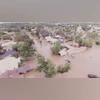
The Kerrville area of Texas, United States, turned into a watery grave for more than 130 people when a flash flood caused the Guadalupe River to suddenly swell on July 4, the US Independence Day weekend.
Being labelled as the worst in American history, the flash flood dumped over a foot of rainfall in under an hour on Texas Hill Country, which is so vulnerable to floods that it has come to be called “Flash Flood Alley”. In barely five hours, the Guadalupe River went from around 1 to 34 feet.
While rescue efforts are on — over 100 people are still reported missing — questions are being raised about the lack of flash flood warning sirens in Kerr County and staffing shortages at the National Weather Service, which is responsible for forecasting weather and issuing warnings across the US. The Trump administration’s funding cut to the National Oceanic and Atmospheric Administration (NOAA) is also being blamed.
The devastating Texas incident has a lesson for India, where flash floods aren’t unusual.
The questions being asked here are: How prepared is India to prevent or deal with such a weather emergency? Does the country have adequate advance warning systems that can help prevent loss of life and property? Also, who in India is responsible for sending warning signals for something like a flash flood?
But first: What is a flash flood?
Flood in a flash
According to the World Meteorological Organisation (WMO), flash floods are sudden bursts of water gushing from a water body, usually within 3-6 hours of heavy rainfall in that area.
Though riverbanks and hilly areas with rivers in their vicinity are more prone to flash floods, these can occur even in plains. Flash floods are usually localised events, but given that their intensity is grave, they can cause serious damage to human life and property.
The WMO rates flash floods as among the world’s deadliest natural disasters, accounting for over 5,000 deaths every year.
These events have grave social, economic, and environmental impact, with instances of entire communities or villages being wiped off in a matter of hours.
WMO says flash floods account for almost 85 per cent of all flooding cases, and also for the highest mortality rates among all classes of flooding, including riverine and coastal flooding.
With climate change increasing the number of adverse weather events and human habitation spreading in hitherto untouched areas, flash floods have become more frequent and devastating over the years.
The India story
India is no stranger to flash floods.
In fact, every monsoon season — and even outside of it — sudden, short, intense bursts of rain in areas around water bodies, mostly in hilly regions, have been causing flash floods with increasing frequency.
The Kedarnath (Uttarakhand) disaster of June 2013, which washed away almost the entire temple town, was one of the worst incidents of flash floods in India.
The disaster, caused by a cloudburst in the high regions, claimed over 6,000 lives, making it one of the world’s worst natural disasters.
The Uttarakhand administration had then gone on record to say the state was ill-prepared to handle a calamity of such a proportion and that the early warning systems were inadequate.
Flash floods have struck India multiple times since with varying intensities, claiming lives and damaging property in the northern Himalayan region, in the hills of Northeast, as well as in southern India.
This year, since June 2025, flash floods and landslides in Himachal Pradesh have claimed over 100 lives across Mandi, Kullu, Kangra, and other districts. They have also caused extensive damage to property, crops, and livestock.
For an early warning
It has been 12 years since the Kedarnath flood. India is again in the middle of the monsoon season, with July and August as the two most critical rainfall months.
So, is India any better prepared to handle flash floods than it was in 2013? Also, what kind of early warning systems have been put in place?
Ask Mrutyunjay Mohapatra, director general of Meteorology, India Meteorological Department (IMD), and he says the country has made a concerted effort to deal with flash floods.
In 2021, India set-up a ‘flash floods guidance system’, not just for itself but for the whole of South Asia, covering countries like Nepal, Bhutan, and Bangladesh, he says.
This guidance system has mapped and covered over 100,000 watersheds across the region, he adds.
According to NOAA, watershed is a land area that channels rainfall and snowmelt to creeks, streams, and rivers, and eventually to outflow points such as reservoirs, bays, and the ocean.
“In simple terms, a watershed is nothing but an area where water can accumulate,” Mohapatra explains.
He says that each watershed that has been mapped by IMD covers an area of around 4 km by 4 km.
“In other words, a forecast for a watershed covering an area of approximately 16 km is being provided four times a day — that is, at an interval of every six hours,” Mohapatra says.
Then there is something called ‘flash flood risk’, which is shared 24 hours before the occurrence of any event.
“All this guidance is being provided in different colour codes: yellow, orange, red, and green, depending upon their intensity – just the way we give a normal rainfall forecast,” Mohapatra says.
He adds that if there is a forecast for 24 hours, one can prepare. “And, if there is a forecast for the next 6 hours, then one has to take immediate action.”
On-ground action
This raises another question: How personalised is the adverse weather warning system for events such as flash floods?
Mohapatra says that the ‘Common Alert Protocol’ developed by the National Disaster Management Authority (NDMA) offers personalised weather warnings.
Also, several states across the country have developed their own systems to provide personalised weather warnings for events such as heavy rainfall, thunderstorms, heat waves, cold waves, and cyclones etc, he adds.
The emergency operations centre across states also provide early warning on adverse weather systems. And then there are mobile applications such as ‘Sachet’, which offer early warning of adverse weather events in a localised area.
That said, flash floods do not yet figure in the common alert protocol, though there is a move to include them in it.
“While IMD is the technical partner for providing the forecast, and NDMA coordinates (the disaster response), disseminating the final early warning is a task that lies with the state government,” Mohapatra says.
It is the state’s job to enter into agreements with telecom service providers to ensure that such warnings go directly into the mobile phones of subscribers, so that loss of lives and property is prevented — or at best minimised.
Clearly, when it comes to unforeseen weather events such as flash floods, coordination among all agencies concerned is key – something that was perhaps missing in Texas.
Deep waters
What is a flash flood?
It is a sudden burst of water gushing from a water body, usually within 3-6 hours of heavy rainfall in that area
How devastating is it?
It is among the world’s deadliest natural disasters, accounting for over 5,000 deaths every year and for almost 85% of all flooding cases. Flash floods also have the highest mortality rates among all classes of flooding.
In India, since June 2025, flash floods and landslides in Himachal Pradesh have claimed over 100 lives across Mandi, Kullu, Kangra, and other districts. They have also caused extensive damage to property, crops and livestock
2.5 billion
Number of people affected by floods between 1994 and 2013
$40 billion
Damage caused by floods annually around the world
24%
Estimated increase in the number of people living in flood-prone areas between 2000 and 2015
Source: World Meteorological Organisation