
India plans green hydrogen incentives of at least 10% of cost: Report
According to the report, the government will give incentives worth at least 30 Indian rupees per kg for production of green hydrogen fuel
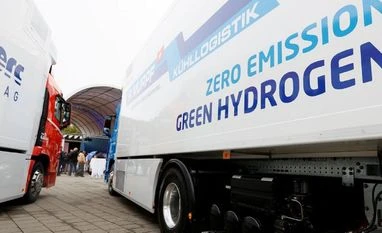 "India plans green hydrogen incentives of at least 10% of cost: Report")
Explore Business Standard
According to the report, the government will give incentives worth at least 30 Indian rupees per kg for production of green hydrogen fuel
By Sarita Chaganti Singh
NEW DELHI (Reuters) -India plans to give green hydrogen fuel producers incentives worth at least 10% of their costs under a $2 billion scheme set to begin before the end of June, a top government official said.
New Delhi this year approved a 174.9 billion rupee incentive plan to promote green hydrogen in a bid to cut carbon dioxide emissions and become a major exporter in the sector.
The government will give incentives worth at least 30 Indian rupees per kilogram (kg) for production of green hydrogen fuel, the official, who is directly involved but did not want to be identified because the discussions are private, told Reuters.
The cost of manufacturing green hydrogen, which is made using renewable energy rather than power derived from fossil fuels, in India is currently at about 300 rupees per kilogram.
Of the total incentive plan for the sector, the government will award about 130 billion rupees for producing green hydrogen and rest will be for manufacturing electrolysers, which are used to split hydrogen and oxygen molecules using electricity.
India has set targets for half of its installed electricity capacity to be from non-fossil fuel sources by 2030 and for the country to attain net-zero carbon emissions by 2070.
India's Ministry of New and Renewable Energy and Press Information Bureau did not immediately respond when asked for comment on the scheme by Reuters.
The government will start the bidding for firms seeking incentives before the end of this quarter, the source said, adding that the incentives will be tapered every year and the government expects to support 3.6 million tonnes of hydrogen production capacity in the next three years under the scheme.
The government will invite bids in three tranches for green hydrogen supply and in two tranches for electrolysers, the official said, adding that this will help gain market insights and to absorb new technologies and realise cost reductions.
The auction for green hydrogen supply is expected to be open to companies which have renewable energy plants or produce hydrogen and ammonia. Companies seeking the lowest incentive will be awarded the contracts, the source said.
Indian companies such as Reliance Industries, Indian Oil, NTPC, Adani Enterprises, JSW Energy, ReNew Power and Acme Solar that have already announced plans for green hydrogen are expected to be interested in the contracts.
Each tranche for manufacturing of electrolysers is likely to be for 1,500 megawatts (MW) of capacity, with the incentive fixed at 4,440 rupees per kilowatt, the official said.
The government expects to support about 3,000 megawatts of annual electrolyser capacity for five years through the scheme, with the first tranches in this quarter and the next in the third quarter of 2023.
(Reporting by Sarita Chaganti Singh; Editing by Alexander Smith)
(Only the headline and picture of this report may have been reworked by the Business Standard staff; the rest of the content is auto-generated from a syndicated feed.)
First Published: Apr 06 2023 | 9:33 AM IST


