India's goal to improve higher education enrolment seems hard to get

Country will need more universities and colleges to meet 2035 target set by National Education Policy
Class, School, Teacher, Students, Student, Education, Study
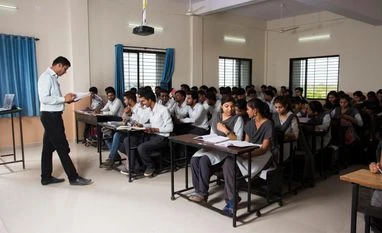
India is unlikely to achieve the target of reaching Gross Enrolment Ratio (GER) in higher education to 50 by 2035. (Photo: Shutterstock)
Yash Kumar Singhal New Delhi
1 min read Last Updated : Nov 22 2024 | 11:56 AM IST
India is unlikely to achieve the target of reaching Gross Enrolment Ratio (GER) in higher education to 50 by 2035: A goal set by the National Education Policy in 2020.
 
GER is a measure of the number of people enrolled in a particular level of education relative to the population. Although GER in higher education has been improving at a compounded annual growth rate (CAGR) of 3.65 per cent from 24.6 per cent in 2017-18 to 28.4 per cent in 2021-22, it won't be enough to reach the goal for 2035. (chart 1) 
 
India will need more higher educational institutions (HEIs) such as universities, colleges and stand-alone institutions for that. B V R Subrahmanyam, chief executive officer of Niti Aayog, recently said that India will have to raise the number of universities to 2,500.
 
In 2017-18, there were 36.6 million students enrolled in HEIs that included 903 registered universities (both private and state-owned). The numbers increased to 43.3 million students enrolled at 1,168 registered universities in 2021-22, according to the government’s All India Survey on Higher Education (AISHE) report. There are now 1,317 registered universities on the AISHE dashboard, registering a 5.53 per cent CAGR from 2017-18 to 2024-25. At this rate, India will fall short of the 2,500 universities mark in 2035. (chart 2) 
 
The Union cabinet early in November approved the PM-Vidyalaxmi scheme to provide financial support to “meritorious students” seeking to pursue higher education. The number of people buying education loans declined in 2018-19 to 2020-21 but in the past two years the amount of such credit disbursed by state-owned banks as well as the number of accounts have increased. The share of loans taken to study abroad has increased from 27.33 per cent in FY14 to 46.78 per cent in FY22. The share of loans taken to study in India has declined. (chart 3) 
 

One subscription. Two world-class reads.

Already subscribed? Log in

Subscribe to read the full story →
*Subscribe to Business Standard digital and get complimentary access to The New York Times

Smart Quarterly

₹900

3 Months

₹300/Month

SAVE 25%

Smart Essential

₹2,700

1 Year

₹225/Month

SAVE 46%
*Complimentary New York Times access for the 2nd year will be given after 12 months

Super Saver

₹3,900

2 Years

₹162/Month

Subscribe

Renews automatically, cancel anytime

Here’s what’s included in our digital subscription plans

Exclusive premium stories online

  • Over 30 premium stories daily, handpicked by our editors

Complimentary Access to The New York Times

  • News, Games, Cooking, Audio, Wirecutter & The Athletic

Business Standard Epaper

  • Digital replica of our daily newspaper — with options to read, save, and share

Curated Newsletters

  • Insights on markets, finance, politics, tech, and more delivered to your inbox

Market Analysis & Investment Insights

  • In-depth market analysis & insights with access to The Smart Investor

Archives

  • Repository of articles and publications dating back to 1997

Ad-free Reading

  • Uninterrupted reading experience with no advertisements

Seamless Access Across All Devices

  • Access Business Standard across devices — mobile, tablet, or PC, via web or app

Topics :New education policyIndian educationeducationhigher educationSchools

Next Story


