
Lok Sabha passes Anusandhan National Research Foundation Bill for research
The Lok Sabha on Monday passed the Anusandhan National Research Foundation Bill to set up a national agency to fund research across universities in the country
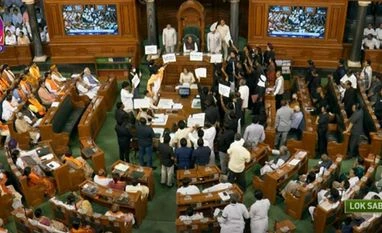 "Lok Sabha passes Anusandhan National Research Foundation Bill for research")
Explore Business Standard
The Lok Sabha on Monday passed the Anusandhan National Research Foundation Bill to set up a national agency to fund research across universities in the country
The Lok Sabha on Monday passed the Anusandhan National Research Foundation Bill to set up a national agency to fund research across universities in the country.
Science and Technology Minister Jitendra Singh had introduced the Anusandhan National Research Foundation Bill-2023 on Friday in the Lower House.
The bill seeks to set up a Rs 50,000-crore fund, with a sizeable contribution from the private sector by tapping into the corporate social responsibility (CSR) funds, to "seed, grow and promote" research and development (R&D) and foster a culture of research and innovation throughout India's universities, colleges, research institutions, and R&D laboratories.
"PM Narendra Modi has provided an enabling milieu due to which over the last nine years, many taboos of the past were broken, space was opened up for the private sector that is why many startups are working with ISRO. It was our Chandrayan that brought pictures of water and today organisations like NASA are waiting for our findings for their research," Singh said.
The National Research Foundation (NRF) will be set up with a budget of about 50,000 crore for a period of five years, with Rs 10,000 crore from the government, Rs 4,000 crore from the Science and Engineering Research Board (SERB) and Rs 26,000 crore from places like the private sector, from philanthropists or other aid.
The minister said with the formation of NRF, India will join other countries in having such an organisation and expressed hope that it will soon surpass them.
Explaining the need for the bill, the minister said India's existing system had a missing link. He said that in the area of funding, mostly the centres and departments are in universities, but research is also done in science institutes and IITs. Singh noted that the funds are granted on the basis of competition and often the IITs would take away 65 per cent of the funds.
"Only about 11 per cent would remain with the state universities. So, this bill empowers states," he said.
The minister said the bill seeks to set right the R&D funding which, presently, is "skewed in favour of IIT and other elite institutes".
He said the NRF is meant to ensure greater participation and that scientific research is funded equitably.
The SERB, which was set up through an Act of Parliament, will be subsumed in the NRF and provisions have been made in the bill to ensure that the sanctioned projects keep receiving funds.
The bill seeks to set up different funds - the Anusandhan National Research Foundation Fund, for the financing of activities under the Act; the Innovation Fund for supporting outstanding creativity in the areas supported by the Foundation; the Science and Engineering Research Fund for continuation of the projects and programmes initiated under the Science and Engineering Research Board Act, 2008; and one or more Special Purpose Funds for any specific project or research.
"The time has come to bridge the gap between the public and the private sector because we have to bring development collectively. We have to get rid of barriers. The NRF will also take care of how to link industry to research so that we have a healthy synergy among research, academia, start ups and entrepreneurship," the minister said.
He said the NRF will focus on creating a policy framework and putting in place regulatory processes that can encourage collaboration and increased spending by the industry on R&D.
The NRF will have a governing board consisting of 15 to 25 eminent researchers and professionals, and it will be headed by the Prime Minister. The Education Minister and the Science and Technology Minister will be the vice presidents of the NRF. There will also be a provision to nominate members to bring in the private sector.
The proposed foundation will also have an executive council under the principal scientific advisor, Singh said.
"Our parameters have to be global. Earlier, we were constraining ourselves because of self-made barriers. Modiji has freed us from such barriers," he said.
(Only the headline and picture of this report may have been reworked by the Business Standard staff; the rest of the content is auto-generated from a syndicated feed.)
First Published: Aug 07 2023 | 6:43 PM IST


