
Odisha train tragedy: Initial probe indicates flaws in signalling system
She further explained that only the Coromandel Express was involved in the accident and fell on the down-line (the main line) on which the Yashwantpur Express was approaching
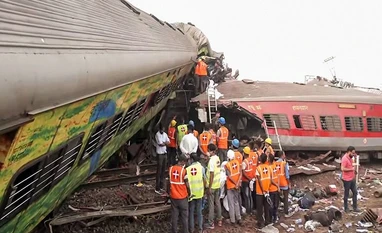 "Odisha train tragedy: Initial probe indicates flaws in signalling system")
WebinarsNew
Deep DiveNew
Explore Business Standard
She further explained that only the Coromandel Express was involved in the accident and fell on the down-line (the main line) on which the Yashwantpur Express was approaching
Initial probe in the Odisha train tragedy has revealed a problem with the signalling system, a Railway Board official said on Sunday while confirming the cause of the accident.
Jaya Varma Sinha, the member of the Railway Board responsible for Operations and Business Development, shared preliminary information regarding the Odisha train tragedy. She further stated that the Board has set up an independent inquiry.
"However, we are still awaiting a comprehensive report from the Commissioner of Railway Safety to obtain detailed information, so we cannot disclose more at this time," she said.
Sinha mentioned that the Coromandel Express was running at a speed of 128 KMPH, while the Yaahwantpur Express (Bengaluru-Howrah) was moving at 126 KMPH. Both trains were allowed to travel at a maximum speed of 130 KMPH, so there was no question of overspeeding.
She further explained that only the Coromandel Express was involved in the accident and fell on the down-line (the main line) on which the Yashwantpur Express was approaching.
"The Coromandel Express collided with a goods train carrying iron. The impact of the collision was so strong that the coaches of the Coromandel Express split and fell onto the railway tracks, while the goods train didn't even budge. Meanwhile, the Yashwantpur Express was also approaching on another track when the coaches of the Coromandel Express fell. The Yashwantpur Express had almost passed, but within a fraction of a second, its last two coaches collided with the detached coaches of the Coromandel Express, causing damage," she said.
The Railway official stated that the digital records do not show any errors. She mentioned that those responsible have been identified but didn't reveal their names as they were awaiting the detailed report.
"Currently, restoration work is in progress at the incident site, and it is anticipated that two Railway lines will be operational by 8 p.m. today. However, trains are expected to operate at reduced speeds initially. An inquiry is underway, with investigations being conducted from various perspectives. While the initial assessment suggests that the issue could be related to signalling, no conclusive authentication can be provided at this time," Sinha said.
--IANS
atk/uk/
(Only the headline and picture of this report may have been reworked by the Business Standard staff; the rest of the content is auto-generated from a syndicated feed.)
First Published: Jun 04 2023 | 4:14 PM IST


 Connect with us on WhatsApp