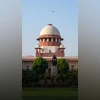
The Supreme Court on Monday agreed to examine a plea over issue of blocking of social media accounts or content without an opportunity to be heard to the creator or originator.
A bench of Justices B R Gavai and Augustine George Masih sought Centre's response on the petition for quashing Rule 16 of the Information Technology (Procedure and Safeguards for Blocking for Access of Information by Public) Rules, 2009.
The bench issued notice on the plea.
Senior advocate Indira Jaising, appearing for petitioner Software Freedom Law Center, said no notice was given to the "originator" of the information and a notice was only sent to platforms like X.
"The challenge is not that the government does not have the power to take down information, but while taking down the information, notice should be given to the person who has put that information in the public domain," she said.
The plea, filed through advocate Paras Nath Singh, challenged the validity of certain provisions of the 2009 Rules.
By making optional the issuance of blocking request notice to the originator of the content, Rule 8 vested "unguided discretion" in the authorities whether or not to issue a notice to the originator, it said.
The bench initially said an aggrieved person could approach the court on the issue and observed if the person was identifiable, notice would be given and if the person who hosted the information was unidentifiable, the intermediary would be served.
"The challenge is that the rules of natural justice is not complied with in relation to person who originates the information," Jaising said.
Justice Gavai prima facie observed that the rule had to be read in a manner where if a person was identifiable, notice had to be given.
When Jaising said the court would be familiar with social media, Justice Gavai said he was not on any social media platform.
"I am not on either X, Y or Z," he said.
The bench said an identifiable person, who was not given a notice and was aggrieved, could approach the court.
The plea said there were numerous instances of websites, applications and social media accounts being blocked without a notice or an opportunity to be heard.
"The blocking rules, 2009, in their present form, effectively allow the respondents to block online content posted by citizens without providing any rationale and without affording any chance for the owner or poster of the content to be heard," it said.
The 2009 rules, the plea said, also mandated all complaints and requests made for blocking of content were to be kept confidential.
"This position of law results in a citizen being deprived of their fundamental rights under Article 19(1)(a) and 21 of the Constitution and confronted with the (metaphorical) 'inscrutable face of a sphinx'," it said.
An urgent intervention of the apex court was crucial to protect the fundamental right of speech and expression of citizens, which was necessary both for the liberty of individual as well as the democratic fabric of the society, the plea added.
Referring to Section 69A of the Information Technology Act, 2000, dealing with the power to issue directions for blocking public access to any information through any computer resource, the plea sought directions for the intermediary and the content creator or originator to be served a notice.
(Only the headline and picture of this report may have been reworked by the Business Standard staff; the rest of the content is auto-generated from a syndicated feed.)

 "SC to hear petition against blocking social media content without notice")


 Connect with us on WhatsApp