
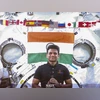
Shubhanshu Shukla conducts stem cell study on ISS, records digestion video
Group Captain Shukla also recorded an educational video for Indian school students explaining how the human digestive system adapts in space
 "Shubhanshu Shukla conducts stem cell study on ISS, records digestion video")
Explore Business Standard
Group Captain Shukla also recorded an educational video for Indian school students explaining how the human digestive system adapts in space
Indian Space Research Organisation (Isro) astronaut and Group Captain Shubhanshu Shukla, currently aboard the International Space Station (ISS) as part of the Axiom Mission 4 (Ax-4), conducted a series of scientific experiments on Monday focused on muscle health, digestion in space, and astronaut mental well-being.
According to Nasa, Shukla worked inside the Kibo laboratory's Life Sciences Glovebox to study how muscle stem cells behave in microgravity. He also recorded an educational video for Indian school students explaining how the human digestive system adapts in space.
Nasa said, "Indian astronaut Shubhanshu Shukla filmed a video targeted to young Indian students discussing how the digestion system adapts to space. Next, Shukla worked in Kibo's Life Science Glovebox checking muscle stem cell cultures to learn how to maintain muscle health in space."
The Life Sciences Glovebox is a sealed and sterile workspace aboard the ISS that allows astronauts to safely handle biological samples in microgravity. It is large enough to allow two astronauts to work together and is used for experiments requiring clean conditions.
According to Nasa, Isro's experiment, Myogenesis, investigates how muscle cells regenerate in space. Astronauts tend to lose muscle mass during extended missions, partly due to microgravity disrupting the function of mitochondria, the part of the cell responsible for energy production. The study involves testing certain metabolic supplements to see if they can improve muscle repair in microgravity. Results from the research may help in developing treatments for age-related muscle loss or muscle-wasting diseases on Earth, in addition to improving astronaut health during long-duration spaceflights.
Nasa explained the purpose, saying, "Astronauts lose muscle mass and the ability of muscle cells to regenerate during spaceflight, which may be due to microgravity interfering with metabolism in mitochondria, cell structures that produce energy. The Effect of Metabolic Supplements on Muscle Regeneration Under Microgravity (Myogenesis - Isro) investigation on the Axiom 4 (Ax-4) private astronaut mission uses muscle stem cell cultures to examine the muscle repair process and test chemicals known to support mitochondrial function. Results could lead to interventions that maintain muscle health during long-term space missions and help people on Earth with muscle-related challenges such as age-related muscle loss and muscle-wasting diseases."
Other Ax-4 crew members also contributed to scientific research. Mission Commander Peggy Whitson used the Ultrasound 2 device to perform vein scans on Hungarian astronaut Tibor Kapu, to help understand how space affects blood pressure, balance, and vision.
According to Nasa, the Ultrasound 2 on the International Space Station (ISS) is a modified commercial off-the-shelf (COTS) ultrasound system that provides high-resolution ultrasound images of target areas in the human body."
Polish astronaut Slawosz Uznanski-Wisniewski tested a brain-computer interface using a special headset developed by the European Space Agency (ESA). He later joined Whitson and Shukla in filming content for an astronaut mental health study. Nasa stated, "The Thoughts over Gravity, a Test of Using fNIRS-based Brain, Computer Interface in LEO Conditions (PhotonGrav) investigation verifies the effectiveness of near-infrared technology (fNIRS) in low Earth orbit to record brain activity for constructing brain-computer interfaces (BCI) operated in the microgravity environment."
Commenting on the crew's schedule, Nasa said, "The Ax-4 private astronauts had a science-packed Monday fulfilling research objectives for their home countries."
The Ax-4 mission is taking place alongside the activities of the ISS's regular Expedition 73 crew. While Ax-4 focuses on privately funded science, Expedition 73 astronauts continue to work on Nasa- and ESA-backed research related to human health and biology in space.
Nasa Flight Engineers Anne McClain and Nichole Ayers conducted muscle stimulation tests using biomedical equipment to examine how muscles react to electrical signals. McClain also completed cognitive tests to study how spaceflight affects brain function. Ayers and fellow astronaut Jonny Kim processed blood samples, including collections from Whitson and Uznanski-Wisniewski, for ESA's Bone on ISS study on space-induced bone loss.
JAXA Commander Takuya Onishi collected and stored his own blood and urine samples for long-term health monitoring. He also worked on air quality monitoring inside the Kibo module. Russian cosmonauts Sergey Ryzhikov and Alexey Zubritskiy trained for the arrival of the "Progress 92" cargo spacecraft and loaded the outgoing "Progress 90" with waste for departure. Another cosmonaut, Kirill Peskov, underwent a 24-hour heart and blood pressure monitoring session and prepared the European robotic arm for upcoming operations.
Summarising the week's activities, Nasa said, "The seven-member Expedition 73 crew wrapped up a weekend of housecleaning and relaxation, then kicked off Monday with muscle and brain research aboard the International Space Station. Their Axiom Mission 4 (Ax-4) counterparts worked throughout the weekend and began the week taking a closer look at muscle cells and exploring brain-computer interfaces."
On June 26, Shubhanshu Shukla became the first Indian to board the International Space Station.
The Ax-4 crew includes former Nasa astronaut Peggy Whitson, Isro astronaut Shubhanshu Shukla, and ESA astronauts Slawosz Uznanski-Wisniewski of Poland and Tibor Kapu of Hungary. The mission is expected to last up to 14 days.
Axiom Mission 4 was launched at noon IST on June 25 aboard a SpaceX Falcon 9 rocket from Launch Complex 39A at Nasa's Kennedy Space Centre in Florida. The Dragon spacecraft successfully docked with the ISS on June 26 at 4:05 pm IST, ahead of schedule, connecting to the space-facing port of the station's Harmony module.
(Only the headline and picture of this report may have been reworked by the Business Standard staff; the rest of the content is auto-generated from a syndicated feed.)
First Published: Jul 01 2025 | 9:50 AM IST


