
Two key features of Chandrayaan: A Tamil connect and a scientific payload
The Tamil connection of the Chandrayaan missions refers to the three scientists from Tamil Nadu who helmed each of the crucial Moon missions of India's space programme
 "Two key features of Chandrayaan: A Tamil connect and a scientific payload")
Explore Business Standard

Associate Sponsors
Co-sponsor
The Tamil connection of the Chandrayaan missions refers to the three scientists from Tamil Nadu who helmed each of the crucial Moon missions of India's space programme
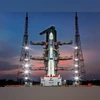
Two key features that mark the Chandrayaan-3 mission by Isro, apart from the planned soft-landing on the lunar surface, is its Tamil connection and the presence of the scientific payload onboard the propulsion module.
The Tamil connection of the Chandrayaan missions refers to the three scientists from Tamil Nadu who helmed each of the crucial Moon missions of India's space programme.
Mayilsamy Annadurai, dubbed as the 'Moon Man of India', led the maiden Chandrayaan mission in 2008, while M Vanitha led the Chandrayaan-2 mission in 2019, and M Veeramuthuvel is heading the current Chandrayaan-3 Mission.
After Chandrayaan-3's lift-off on July 14 at 2.35 pm from Satish Dhawan Space Centre, Sriharikota, Veeramuthuvel rushed back to the Isro Telemetry, Tracking and Command Network (ISTRAC) in Bengaluru to track the rocket.
He told the media that he would be able to speak to them only after ensuring that the landing module makes a soft-landing on the lunar surface an exercise which is planned for August 23 at 6.04 PM.
Besides the people involved in the mission, the other significant aspect of the Chandrayaan-3 mission apart from demonstrating a safe soft landing on the surface of the Moon is the SHAPE' payload on the propulsion module.
SHAPE, which stands for Spectro-polarimetry of HAbitable Planet Earth, is an experimental payload onboard the Chandrayaan-3 mission, which will study spectro-polarimetric signatures of Earth in the near-infrared wavelength range, Isro said.
"It is the only scientific payload on the propulsion module of the Chandrayaan-3 mission," Isro said.
Conceptualised by the U R Rao Satellite Centre, Bengaluru, the main goal of the SHAPE experiment is to characterise Earth's integrated spectrum and polarisation signatures at various phase angles from the vantage point of lunar orbit.
The key science questions which are aimed at being addressed with the SHAPE payload are -- what could be the disc-integrated spectrum of an Earth-like exo-planet and what could be the disc-integrated 'polarisation' from an Earth-like exo-planet, Isro said.
On August 17, the Chandrayaan-3 mission achieved a major milestone when the lander module, carrying the rover inside it, successfully separated from the propulsion module which carries the SHAPE payload.
The SHAPE payload employs an Acousto-Optic Tunable Filter based element driven by a Radio Frequency source and has a pair of Indium Gallium Arsenide (InGaAs) detectors.
The instrument has been developed by the Space Astronomy Group at U R Rao Satellite Centre, Bengaluru.
A key finding of the SHAPE payload would be future discoveries of smaller planets in reflected light, which would allow Isro to probe into a variety of exoplanets (planets beyond our solar system) that would qualify for habitability or for the presence of life.
(Only the headline and picture of this report may have been reworked by the Business Standard staff; the rest of the content is auto-generated from a syndicated feed.)
First Published: Aug 23 2023 | 9:49 AM IST

