Dealerships face inventory glut in August as car buyers await GST cuts

VAHAN data shows 3% m-o-m drop in retail auto sales; EV market hopes hold up
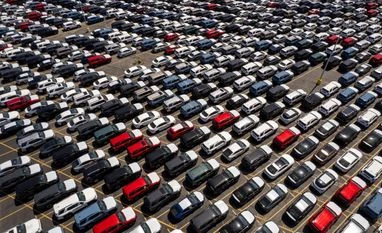
cars, toyota
Dispatches from original equipment manufacturers (OEMs) also slowed in the last week of August as retail sales nearly came to a standstill. Image: Bloomberg
Shine JacobSohini Das Chennai/Mu
4 min read Last Updated : Sep 01 2025 | 9:51 AM IST
Automobile dispatches and retail sales were hit in the second half of August as confusion around goods and services tax (GST) implementation held customers back from placing orders at dealerships. Data from the Vahan portal showed a 3 per cent drop in sales in August compared to July — total automobile retail sales were 1,916,350 units in August versus 1,970,559 units in July.
 
These numbers are as of August 30 and may vary when final registration figures are released.
 
Dispatches from original equipment manufacturers (OEMs) also slowed in the last week of August as retail sales nearly came to a standstill.
 
In July, there was a 10.8 per cent month-on-month jump in retail sales in the passenger vehicle (PV) segment compared to June. The Ashadha period, auspicious delivery days, targeted schemes, new-model launches, and aggressive rural marketing powered hinterland sales, which picked up decisively towards month-end. Multiple dealers across the country reported that sales have now stalled.
 
“Most OEMs, except for Mahindra & Mahindra (M&M), continue to push cars to dealerships. Inventory levels have soared to up to 75 days for some dealers, and we have opened discussions with OEMs on how best to work around this,” said the owner of a multi-brand dealership in South India.
 
Federation of Automobile Dealers Associations had reported inventory levels steady at 55 days at the end of July. Dealer sources now indicate that inventories for several brands have crossed 65–70 days at some dealerships.
 
Major OEMs like Maruti Suzuki India and Hyundai Motor India have seen an impact on retail sales, according to the Vahan portal, mainly due to the GST announcement, which is prompting buyers to defer purchases. Market leader Maruti recorded retail sales of 127,717 units versus 134,160 in July. Hyundai’s numbers also fell to 41,535 units as of August 30, compared with 43,796 in the previous month.
 
Even luxury OEMs reported a slowdown. Hardeep Singh Brar, president and chief executive officer of BMW Group India, said, “The recent speculation about changes in GST rates has caused uncertainty among consumers. Interest and demand remain strong, but buyers are taking a wait-and-watch approach, delaying decisions and impacting new vehicle sales to some extent.”
 
M&M has already stopped wholesale supply of “high-ticket internal combustion engine (ICE) vehicles” above ₹15 lakh to dealers, citing possible losses from the compensation cess and low sales during the month. “Mahindra is supplying some Bolero models, only on dealer demand. Other than that, supply has been halted,” said an industry source.
 
“For the industry, the compensation cess is a concern as companies cannot claim cess credit. Aside from temporarily lower consumer demand, GST will not create a monetary loss,” added another source.
 
While electric vehicles (EVs) are taxed at 5 per cent GST, ICE vehicles face 28–53 per cent (including cess). A reduction in GST rates could reduce tax arbitrage, making EVs relatively less attractive. OEMs are hopeful EVs will continue to enjoy favourable taxation under the new regime.
 
“We also hope that the sustainable push towards electric cars will remain a priority and be reflected in the GST strategy, retaining the existing 5 per cent GST on all passenger EVs. BMW Group India has been an early proponent of electric mobility in India, strategically investing in expansion and localisation of its electric portfolio. Any adverse GST impact could derail the vision for higher EV adoption and local production,” Brar said.
 
Interestingly, the compensation cess will lapse in November and cannot be levied beyond that date. Earlier, it was expected to remain in force until March 2026, primarily on products in the 28 per cent bracket such as automobiles. Although the cess was initially scheduled to end in 2022, it was reportedly extended to enable the Centre to repay pandemic-era borrowings provided to compensate states for revenue shortfall. 
 

One subscription. Two world-class reads.

Already subscribed? Log in

Subscribe to read the full story →
*Subscribe to Business Standard digital and get complimentary access to The New York Times

Smart Quarterly

₹900

3 Months

₹300/Month

SAVE 25%

Smart Essential

₹2,700

1 Year

₹225/Month

SAVE 46%
*Complimentary New York Times access for the 2nd year will be given after 12 months

Super Saver

₹3,900

2 Years

₹162/Month

Subscribe

Renews automatically, cancel anytime

Here’s what’s included in our digital subscription plans

Exclusive premium stories online

  • Over 30 premium stories daily, handpicked by our editors

Complimentary Access to The New York Times

  • News, Games, Cooking, Audio, Wirecutter & The Athletic

Business Standard Epaper

  • Digital replica of our daily newspaper — with options to read, save, and share

Curated Newsletters

  • Insights on markets, finance, politics, tech, and more delivered to your inbox

Market Analysis & Investment Insights

  • In-depth market analysis & insights with access to The Smart Investor

Archives

  • Repository of articles and publications dating back to 1997

Ad-free Reading

  • Uninterrupted reading experience with no advertisements

Seamless Access Across All Devices

  • Access Business Standard across devices — mobile, tablet, or PC, via web or app

Topics :GST RevampAuto industry Indiaautomobile manufacturerAuto salesIndustry Report

Next Story


