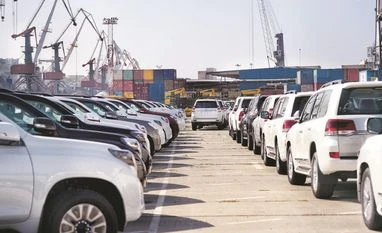
Domestic passenger vehicle (PV) dispatches in the first six months of calendar year 2025 were in the slow lane, with major players like Maruti Suzuki India (MSIL), Tata Motors, and Hyundai Motor India reporting a decline in volumes. Companies like Mahindra & Mahindra (M&M) and Škoda Auto India, however, bucked the trend, riding on the buzz created by new launches.
In June, overall industry volumes dipped. According to industry estimates, wholesales fell 6.4 per cent to 320,000 units. Retail registrations also declined by 4.4 per cent to 294,000 units during the month, industry insiders said.
MSIL, the country’s largest PV player, posted a 2.2 per cent decline in dispatches for first half (H1) 2025 to 880,730 units. In June, dispatches dropped sharply by 13.3 per cent to 118,906 units. MSIL’s utility vehicle (UV) sales also fell in June — from 52,373 units to 47,947 units.
The company said the slowdown in the small car segment was the key reason behind the industry’s muted demand trend. Rahul Bharti, senior executive officer, corporate affairs, MSIL, said that since 2019, the entry-level price point in the industry has risen by over 70 per cent, largely due to stricter regulations, and sales of smaller cars have fallen by over 70 per cent.
“Historically, PV sales used to grow at 1.5x gross domestic product (GDP) growth. But now, even after 6.5 per cent GDP growth, the car market is nearly flat. This is because the once-mass small car segment is not participating in the growth at all. This is clearly an affordability issue,” he said.
Maruti’s small car segment saw a 5.3 per cent decline in sales, reaching 455,009 units in H1 compared to 480,488 units in the same period last year.
What’s concerning as a trend is that the UV segment (comprising models like the Grand Vitara, Brezza, Fronx, etc.) has also seen a decline in volumes.
Tata Motors saw a sharp 15 per cent dip in dispatches in June to 37,083 units (including electric vehicles/EVs). For the first six months of the year, the company posted a 7.89 per cent fall in dispatches to 269,966 units.
Commenting on the trend, Shailesh Chandra, managing director, Tata Motors Passenger Vehicles and Tata Passenger Electric Mobility, said that in May and June there were extreme “volume pressures”. “In the first quarter of 2025-26, the PV industry experienced volume pressures, particularly in May and June, with flat growth reflecting continued softness in demand. However, the EV segment emerged as a bright spot, driven by robust growth and the launch of new EV models across original equipment manufacturers.”
Hyundai Motor India posted a 7.7 per cent drop in dispatches in H1 2025 to 285,809 units. For June, the company recorded a sharp 12 per cent fall in dispatches to 44,024 units.
Tarun Garg, whole-time director and chief operating officer, Hyundai Motor India, said, “In the domestic market, the geopolitical situation continued to affect market sentiment, with domestic sales registering 44,024 units in June 2025. As we come closer to the beginning of production at the Talegaon plant, we remain cautiously optimistic about a gradual recovery in demand, supported by a reduction in repo rates and improving liquidity on account of a cut in cash reserve ratio. We are closely watching the global geopolitical scenario and are committed to delivering value and innovation to our customers across both domestic and export markets.”
EVs, however, seem to have held up better. M&M, which began dispatching its EVs to dealers around March, saw a 20 per cent rise in dispatches in H1 to 301,194 units. In June, the company posted 18 per cent growth in sales to 47,306 units.
Bucking the trend, M&M posted a 20 per cent increase in domestic sales, with the company selling 301,194 units in H1. In June, domestic sales grew by 18 per cent, reaching 47,306 units compared to 40,022 units last year.
Nalinikanth Gollagunta, chief executive officer, automotive division, M&M, said, “In June, we achieved sport utility vehicle (SUV) sales of 47,306 units, a growth of 18 per cent, and total vehicle sales of 78,969 units, a 14 per cent growth compared to the same month last year. The quarter ended on a very positive note for us, marking the highest quarter ever for SUVs.”
Škoda Auto India, which is seeing strong demand for its new compact SUV Kylaq, had its best-ever H1 in its 25-year history in India. Selling 36,194 units between January and June 2025, the company posted a 134 per cent year-on-year rise in dispatches. Škoda’s previous best H1 in India was 28,899 units in 2022.
Ashish Gupta, brand director, Škoda Auto India, said that with the addition of Kylaq to their portfolio, they now have an “SUV for everyone”.
Analysts noted that while overall volumes remain flat, value growth is happening. “While the number of PV sales remains largely flat, overall value growth continues, driven by consumers opting for higher-end models. Over the next two to three quarters, we expect volumes to stay steady, with a slightly more optimistic outlook for rural demand compared to urban areas, supported by better-than-expected monsoon conditions,” said Anurag Singh, advisor, Primus Partners.
In two-wheelers, while overall industry data isn't yet available, major players like Bajaj Auto posted a 16 per cent decline in June dispatches, and H1 2025 was also down 9 per cent for the Pune-based company. On the other hand, premium bike maker Royal Enfield posted a 16 per cent increase in domestic dispatches to 76,957 units compared to 66,117 units last year. For H1, the company posted a 12 per cent increase, selling 228,779 units as against 204,686 last year.