Home / Industry / News / Manohar Lal, Jitendra Singh review roadmap for 100GW nuclear power goal
Manohar Lal, Jitendra Singh review roadmap for 100GW nuclear power goal
Singh highlighted the government's landmark initiative to open the nuclear sector for private sector participation, emphasising its pivotal role in strengthening India's energy security
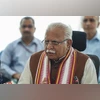
Khattar and Singh outlined several key directives to expedite progress, including streamlining regulatory clearances, investing in technical upgradation and capacity building. (Photo: PTI)
Science and Technology Minister Jitendra Singh on Friday discussed the timeline for achieving the 100 GW nuclear power target by 2047 with Power Minister Manohar Lal Khattar.
At a meeting in Parliament House, the two ministers and senior officials from the Power Ministry and the Department of Atomic Energy reviewed the roadmap to increase India's nuclear energy capacity from the current 8.8 GW to 22 GW by 2032.
The two leaders discussed plans to increase the nuclear power capacity to 49 GW by 2037, scale it up to 67 GW by 2042 and reach the 100 GW target set by Prime Minister Narendra Modi by 2047.
Singh highlighted the government's landmark initiative to open the nuclear sector for private sector participation, emphasising its pivotal role in strengthening India's energy security.
He said there was a strong and vibrant response from the industry to the Bharat Small Modular Reactor (SMR) programme, leading to an extension of the request for proposal (RFP) submission deadline to September 30 to encourage wider participation.
Khattar and Singh outlined several key directives to expedite progress, including streamlining regulatory clearances, investing in technical upgradation and capacity building.
Singh said the government was committed to handholding and creating awareness among private sector players.
India is developing three different types of small modular reactors (SMRs), including one dedicated to the production of hydrogen, mostly in the form of captive plants for energy-intensive industries.
The captive power plants are those facilities which are operated and used by an energy-intensive organisation for its own consumption.
The three types of SMRs 200 MWe Bharat Small Modular Reactor (BSMR), 55 MWe SMR and 5 MWth High Temperature Gas Cooled Reactor for the production of hydrogen are being designed and developed indigenously.
Presently, the installed nuclear power capacity in the country comprises 25 reactors with a total capacity of 8,880 MW, including RAPS-1 (100 MW), which is under long-term shutdown.
Two units of Kakrapar Atomic Power Station (KAPS) with a generation capacity of 700 MWe each and one 700 MWe unit at Rajasthan Atomic Power Project (RAPP-7) have already commenced commercial operation.
At present, 18 reactors with a total capacity of 13,600 MW, including the 500 MW Prototype Fast Breeder Reactor implemented by BHAVINI, are at various stages of implementation.
(Only the headline and picture of this report may have been reworked by the Business Standard staff; the rest of the content is auto-generated from a syndicated feed.)


 "Manohar Lal, Jitendra Singh review roadmap for 100GW nuclear power goal")


