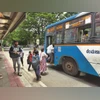
Suvendu, a technical director at an American semiconductor company, drives his car to work from his home in an eastern suburb of Bengaluru.
“I stay in Varthur where the frequency of buses is quite poor. Moreover, if I have to take a bus from my home to my office on Outer Ring Road, I will have to change twice. Also, most of the buses which ply on this route are non-AC, and they get extremely crowded during office hours,” says the senior executive.
Balaram, who works as a cook in Marathahalli, another neighbourhood in eastern Bengaluru, has been here since making his way from West Bengal in 2002. He too takes his motorbike when he has to go to the city centre. “Getting buses from those areas back to Marathahalli is difficult as they are often late.”
Both immigrants (Suvendu is from Tripura), but on opposite ends of the economic scale, the two men face very similar problems commuting to work, which can take up to an hour-and-a-half. Both live on the eastern fringes in bustling neighbourhoods that came up as Bengaluru expanded in keeping with its status as India’s IT hub. And both have been left coping with failing infrastructure and abysmal public transport.
Bengaluru, India’s Silicon Valley, is home to perhaps every prominent global technology company across its famed business parks. Yet, the city has become better known for its notorious traffic snarls — caused by narrow roads, limited public transport and mushrooming private vehicles. Unlike Delhi and Mumbai, cities like Bengaluru that have witnessed rapid urbanisation relatively recently — since the mid-90s — an established and well-oiled public transport system continues to remain a distant dream.
“Bengaluru today stands at a critical juncture. While its metro network is expanding, and Bengaluru Metropolitan Transport Corporation (BMTC) continues to be a reliable urban bus system, the public transport infrastructure still operates below potential. Delhi’s multimodal integration and Mumbai’s suburban rail backbone offer lessons in network density and institutional coordination that Bengaluru has struggled to replicate,” said Naresh Narashiman, an architect and urban designer.
Bengaluru had about 2.53 million four-wheelers and 8.3 million two- wheelers as of March 31, according to data from the state’s transport department. The number of two wheelers and four wheelers were up 24 per cent and 21.7 per cent respectively compared with four years ago while the city’s population, according to various estimates, grew about 12.5 per cent to about 14.5 million in the same period. The faster growth rate is one reason why its roads are perennially congested and commutes take hours.
Tara Krishnaswamy, senior consultant, outreach and partnerships at Indian School of Democracy, cites a lack of public transport culture and the city’s unique economic demographics to explain this state of affairs.
“Cities like Delhi have grown very well while Mumbai and Chennai have a growth of public transport that is parallel to the growth of the city. The state governments there invested in suburban rail and buses. Bengaluru, on the other hand, has grown dramatically.”
All Indian metro cities, she pointed out, had an influx of migrants from the bottom of the pyramid who were employed in manufacturing or automobile sectors. For them affordable public transport was key to sustenance. Bengaluru, on the other hand, had a skewed influx of mostly educated, middle-class engineers who worked in multinational corporations for high salaries and could thus afford private transport.
“The political will or compulsion from governments was not there here and unless we invest in public transport, we will only build flyovers that will enable cars but not buses,” she said.
Priyank Kharge, Karnataka’s minister of electronics, information technology and biotechnology, said at a mobility conclave in September that Bengaluru is projected to grow at about 8.5 per cent till 2035.
“The kind of growth we have and the development expected, it will outpace most of the world’s cities in urbanisation. Seventy-five per cent of the city’s population is working. We have traffic issues but as a government, we cannot say that because we are growing we cannot solve it.”
While the government says it is taking all possible steps to mitigate this problem, the impact is still minimal on the ground. Just 50 per cent of the city’s population uses public transport, according to the government, which aims to increase it to 70 per cent by 2027.
A lot of that heavy lifting will have to be done by the bus and metro corporations —BMTC and Bengaluru Metro Rail Corporation Ltd (BMRCL). While BMTC was hobbled by a fall in demand for its services during the pandemic and by inadequate staff, it is gearing up once again now as demand revives, by adding more buses, increasing daily schedules and recruiting more conductors.
It ran 7,000 buses as of September, ferrying 4.5 million commuters every day. The number of schedules has gone up to about 6,200 as of July, from 5,605 at the end of financial year 2023-24. The total distance covered by these buses daily, however, has gone up by only 4 per cent to 1.17 million km at the end of FY25 from 1.13 million km in FY19.
Experts said the way to reduce congestion on the road is to improve and expand the bus service, increase its frequency and give buses priority lanes to enable faster movement. “If you want to expand public transport it has to be the bus because the cost per kilometre of constructing a metro line is 100 times more than a bus,” said Srinivas Alavilli, a civic activist and fellow at WRI India.
“We have started non-stop express bus services across nine different routes in the city,” said G T Prabhakar Reddy, chief traffic manager, operations, at BMTC. Reddy said the state government has initiated a plan to purchase an additional 4,500 electric buses as part of the PM E-DRIVE scheme that will take up the number of EV buses in the city to 1,800 from 1,600 by the end of the year.
Perhaps the biggest disappointment has been the slow pace of development of the metro railway system, which was launched back in 2011. Phase I of the network started in 2011 but the entire network of 43 km became operational only in 2017. And only 54 km of the proposed 75 km of Phase II have been completed.
Currently 57 trains run in the Purple and Green lines of Phase I while Yellow line of Phase II operates with just four trains, with a fifth expected in early November. For many, reaching a metro station still remains a problem because of the absence of last mile connectivity, with auto rickshaws charging a hefty amount for travelling short distances.
Despite this, the annual daily ridership in metros rose to 636,000 in FY24 from 490,000 in FY20. The BMRCL did not respond to a request for comment on this story.
Kharge summed it up: “We do not have enough urban planners in the city or country and there are knee-jerk development plans for any city.” But, he added, “If there is
any city in India that can bring about the change that people want in mobility and sustainable future, it will be Bengaluru.”
The residents of India’s Silicon Valley will hope he is right.