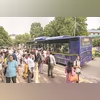
It’s the morning rush. Fresh out of engineering college, 22-year-old Avinash Singh grows restless as he waits for a Delhi Transport Corporation (DTC) bus that seems increasingly unlikely to arrive on time.
“It’s an everyday story. It takes 20-30 minutes for the bus to arrive, and then we’re stuck in traffic. I can’t afford a cab or an autorickshaw. This is my lifeline,” he bemoans.
Across the Kapashera bus stand in Southwest Delhi, commuters like him face the dual burden of hazardous air quality and failing public transport.
Amit Yadav, a 58-year-old clerk in central Delhi, feels he’s at the mercy of a shrinking bus service. “Earlier, there were Blue Line (private) buses to the outskirts. Now they’re gone, and state buses have dwindled,” he laments.
Avinash and Amit’s struggles highlight a gap in India’s growth story — mobility — and citizens are paying the price in both health and money.
Household consumption data from the National Statistics Office (NSO) shows that conveyance remains the largest non-food expense for Indian households. Urban spending on transportation rose to 8.5 per cent (₹592) in 2023-24 (FY24) from 6.5 per cent (₹171) in 2011-12 (FY12). In rural areas, it increased from 4.2 per cent (₹60) to 7.6 per cent (₹312).
In Delhi, urban households spent 8.2 per cent (₹698) of their monthly budgets on commuting in FY24.
Left behind at the bus stop
While the Delhi Metro — hailed as one of India’s biggest infrastructure successes — has transformed the city’s transport landscape, suburban commuters feel that a revolution envisioned two decades ago has left them stranded on a platform suspended in time.
At Kapashera, 44-year-old Ram Saroj recalls that it’s been 20 years since the Metro reached nearby Dwarka, yet Gurugram — one of India’s largest employment hubs — remains inaccessible through a direct line, forcing a long detour.
“The two areas aren’t far, and thousands commute on this route. Still, there’s no connectivity,” he says wryly.
NSO data also shows that rural Delhi households spend more on transport (9.5 per cent) than urban households (8.2 per cent) in FY24.
For women, poor access combines with safety concerns. Experts warn that the economic cost of poor public transport extends beyond commuting.
“Lack of access can disincentivise workforce participation, especially among women and able-bodied elders. Transportation is a key enabler for safe access to workplaces,” says Jagan Shah, chief executive officer of The Infravision Foundation.
The challenge is even tougher for persons with disabilities. According to urban planning expert R Srinivas, only 6 per cent of public transport is accessible.
While last-mile connectivity is a major issue, even accessible public transport poses challenges due to the lack of proper signage, says Sminu Jindal, accessibility advocate and managing director of Jindal SAW. “There’s a need for greater awareness of the issue,” she says.
Private vehicles, public burden
Private vehicles have swarmed Delhi over the past three decades, worsening congestion and pollution. Transport contributes over 50 per cent of the city’s local emissions, according to the Centre for Science and Environment.
Delhi’s FY24 Economic Survey notes that residents avoid public transport due to poor last-mile connectivity and lack of integration. “Growing use of personal cars and two-wheelers has led to a tremendous decline in air quality and traffic safety. In many urban areas, road congestion has increased, and Delhi is already among India’s largest producers of greenhouse gas emissions,” the survey observes.
Public transport has lagged behind population growth. Delhi operates a fleet of about 7,100 buses, while Beijing runs over 27,000 — with a smaller population.
Average daily ridership on Delhi’s buses declined from 5.1 million in 2019-20 to 4.2 million in 2022-23. The Bus Rapid Transit system was abandoned a decade ago, forcing all buses to share congested roads with private vehicles. “Multimodal integration needs hyperlocal design, efficient execution, and strict policing. It’s key to unlocking ridership demand for public transport,” says Shah.
Some delays begin right at the depots. At Seemapuri bus depot, narrow roads, e-rickshaw congestion, and encroachments choke buses for 15 minutes or more, a depot worker explains. “Most buses head towards Anand Vihar or the Meerut Expressway, but that direction is on the opposite side of the depot’s lane, so nearly every bus clogs traffic while trying to make a U-turn,” he says.
Policy paralysis
“Give every Delhi bureaucrat a Mercedes, but not a driver. Maybe then they’ll understand the mobility crisis,” joked a transport official.
A Comptroller and Auditor General of India audit this year highlighted the shrinking DTC fleet — from 4,344 buses in 2015 to 3,937 in 2022 — despite funds being available for procurement.
“The corporation failed to induct new buses (except two e-buses in March 2022 and 298 buses after March 2022 up to November 2022) into its fleet during the past 10 years (the last bus was inducted in FY12),” the audit found.
Jitender Yadav, managing director of DTC, acknowledges the need for urgent action. “We’re procuring 6,000 buses in the next two years. By 2029, Delhi will have 11,000 e-buses.”
Experts say the actual requirement is much higher.
Metro: Engineering marvel, access challenge
Since 2002, the Delhi Metro has become a global benchmark, yet accessibility gaps persist. “The Metro is seen mainly as an engineering solution. From a convenience and access perspective, a lower share of the city’s population uses it compared to the best global systems,” a transport official admits.
According to officials, future plans aim to fix this: Phase-IV’s priority corridors will extend the network by 65 kilometre, while Delhi Metro Rail Corporation (DMRC) is expanding last-mile connectivity.
Fare hikes — 7 per cent in September — reflect operational pressures, particularly loan repayments to the Japan International Cooperation Agency (JICA). DMRC’s outstanding JICA loan stood at ₹30,835 crore in March 2024.
“Delhi Metro fares are competitive compared to other Indian metros, which charge 35 per cent more over medium distances,” says Amit Gupta, partner at EY.
Another urban planning expert notes that fare decisions must balance income levels with broader mobility goals. “Buses keep fares low despite their poor finances, so why does the Metro cite loan repayments when hiking?” he asks.
Shah believes there’s scope to raise Metro revenue and meet obligations through land value capture, a global best practice.
Queries sent to DMRC did not elicit a response until the time of going to press.
Dilli door hai
Delhi’s legacy infrastructure and unplanned growth limit new construction. Experts advocate incentives for shifting from private to public transport. “For car owners, premium service is key. For two-wheelers, reliable transit and real-time information help,” says a senior official.
The government plans to move from 12-metre buses to medium DEVI (Delhi Electric Vehicle Interconnector) buses for faster movement. “A bus management system and real-time mapping interface via vehicle location tracking devices will allow passengers to track buses within six months,” says Yadav.
With legacy routes operating for decades and urban demographics having changed, the department is also carrying out a route and time rationalisation exercise to improve service to Metro stations and peak-hour coverage.
The Delhi Master Plan 2041 envisions integrated transit with unified ticketing, cycling infrastructure, and multimodal nodes.
According to Shah, more coordinated action among urban authorities is needed to ensure transport systems complement rather than compete with each other. The Delhi government is also considering a Unified Metropolitan Transport Authority to centralise planning and operations across DTC, DMRC, and Rapid Regional Transport System.