Global crude oil market: A tense balance of supply and demand
Global oil prices have shown remarkable resilience amid softer economic data from two major consumers: the US and China. US factory activity, as measured by the ISM Manufacturing Index, and China's official Manufacturing Purchasing Manager’s index (PMI) have both eased, with China's reading struggling to stay above the critical 50.0 expansion threshold. This underscores persistent challenges from weak domestic demand and subdued new orders. Meanwhile, Eurozone manufacturing remains sluggish, contracting slightly at 49.6, though business sentiment via the ZEW Economic Sentiment Index signals improving confidence, buoyed by lower energy costs and expectations of a gradual recovery.
Opec+ strategy and production discipline
Opec+ remains the primary architect of global supply management. In their most recent decision, the alliance opted to maintain existing voluntary production cuts totalling approximately 2.2 million barrels per day for the first quarter of 2026. This move, a "tactical pause," signals the group's commitment to market discipline, aiming to prevent a steeper price slide caused by a projected seasonal supply surplus. The decision effectively postpones planned output increases, reinforcing a stable price floor, though internal cohesion remains a concern over future individual country quotas.
Demand forecasts: EIA vs. IEA
Forecasts from key energy agencies highlight an uneven outlook for global oil consumption. Both the US Energy Information Administration (EIA) and the International Energy Agency (IEA) project modest demand growth into 2026, primarily driven by non-OECD nations.
The IEA projects global oil demand to increase by around 0.7 million barrels in 2026, reaching approximately 104.4 million barrels. On the other hand, the EIA is slightly more bullish on consumption, forecasting a growth of 1.1 million for 2026. Crucially, both agencies agree that growth is being held back by a challenging economic environment and the increasing uptake of cleaner energy technologies.
ALSO READ | Bitcoin sees renewed demand, reclaims $93k; check what's driving momentum Asia’s demand engine: China and India
Asia remains the undisputed centre of future oil demand growth, though the pace is shifting. China's demand growth is showing signs of moderation due to economic restructuring and an accelerating shift to electric vehicles and other clean energy sources. The projects China’s consumption to increase by around 0.25mb/d in both 2025 and 2026. China imports have stood around 472 mmt in the first 10 months against 457 mmt for the same period last year. India is emerging as the new epicentre of growth. Driven by rapid industrialisation, expanding vehicle ownership, and petrochemical sector demand forecasts, India to lead global oil demand growth over the next decade, surpassing that of China and Southeast Asia combined. Indian imports rose to 206 mmt in 2025 from 201 mmt in 2024. We expect Indian crude oil consumption should reach around 6mbpd by end of 2026.
US production and the shale plateau
US crude oil production continues to hover near record highs, driven by efficiency gains in the Permian Basin. However, has signalled that the once-relentless growth of shale oil may be peaking. Current forecasts suggest shale output may plateau or start to slightly decline post-2027. For 2026, US production is still expected to rise, contributing significantly to the anticipated global supply surplus, leading to a deeper glut situation.
Geopolitical flashpoints
Geopolitical risks are providing a firm floor under prices, threatening short-term supply stability. Russia and Ukraine: Continued Ukrainian drone strikes on Russian refining and export infrastructure last week attack on the CPC black sea terminal, have kept the market tense, particularly impacting refined products like diesel. While Russia has maintained high crude export volumes, disruptions to its processing capacity increase volatility.
Venezuela: Ongoing sanctions and internal political instability pose a constant risk to supply. Any further tightening of sanctions or internal conflict could immediately threaten the country’s modest yet important export volumes.
Short-term price outlook
The short-term price outlook is a tug-of-war between Opec+ discipline and rising non-Opec supply. The Opec+ decision to hold output in Q1-2026, coupled with geopolitical risk premiums, are stabilising. Brent crude is in the low-to-mid $60 per barrel, and WTI is near $60. However, the anticipated Q1 2026 inventory build, largely driven by the combination of resilient US production and moderate global demand growth, creates downward pressure. We expect oil prices to remain broadly in the range of $57-61, but any flare-up in geopolitical risk could see crude testing resistance of $62. (Discliamer: This article is by Mohammed Imran, research analyst, Mirae Asset Sharekhan. Views expressed are his own.)

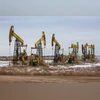 "Crude oil outlook: $57-61 range likely, geopolitical flare-ups may test $62")


