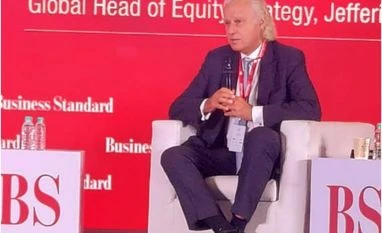
Markets wrong in hoping worst of geopolitical crisis is over: Chris Wood

In its recent GREED & fear note Wood said, in the base case, it expects the Russia-Ukraine conflict to continue in the months leading US presidential election in November.

Chris Wood
Chris Wood
Puneet Wadhwa New Delhi
4 min read Last Updated : Apr 26 2024 | 10:56 PM IST
Global financial markets are wrong in hoping that the worst of the geopolitical flare ups such as the Iran – Israel conflict, and the Russia – Ukraine war is over, wrote Christopher Wood, global head of equity strategy at Jefferies in his recent note to investors GREED & fear.

While most investors and media are focused on Fed policy and the 'endless chatter' of US Fed governors, Wood believes the news flow in the financial sphere pales into complete insignificance compared with the tectonic shifts going on in geopolitics.

“GREED & fear gets the sense that markets are currently hoping that tensions in the Middle East/West Asia have peaked with Israel’s almost formalist kabuki-like response last weekend to Iran’s attack on Israel the previous weekend. While it is natural for markets to have such hopes, that is certainly not GREED & fear’s view. Rather the base case is that in both the Ukraine-Russia conflict and in the Middle East tensions are likely to continue to escalate,” Wood wrote in the latest note.

If the base case, he said, is that the Russia-Ukraine conflict will continue in the months leading up to the November 2024 presidential election in the US, the concern for the Joe Biden administration remains renewed Middle East tensions triggering a further rally in the oil price at a time when the inflation issue is not yet fully dealt with.


“GREED & fear would be astonished if the world has witnessed the last of Israel’s actions against Iran following last week’s formalised response, though Israel can clearly bide its time in terms of when to implement a more telling response, with the obvious high beta play an Israeli attack on Iran’s nuclear facilities,” Wood wrote.

Such a move before the US Presidential election in November this year, Wood believes, would be extremely provocative, given the likely impact on oil prices and related financial markets.


Brent crude oil prices, meanwhile, continue to trade firm around the $90 a barrel mark. This far in calendar year 2024 (CY24), Brent crude oil has risen around 17 per cent from nearly $79 a barrel as at the end of December 2023. A large part of this rise has been on account of geopolitical issues, besides OPEC+ moves to restrain supply.

Investment strategy

Going ahead, if geopolitical tensions between Iran and Israel escalate significantly, analysts at UBS warn that there will be a risk of panic selling and increased volatility across global stock markets. Moreover, the markets, especially the Indian stock market, will be keeping a close eye on the fluctuations in crude oil prices, as geopolitical events such as the Iran – Israel conflict frequently impact them.


That said, analysts at UBS suggest investors do not panic and sell stocks or exit the stock markets even if tensions due to the geopolitical events such as Iran – Israel conflict escalate. While stock market experts caution against the volatility in the global stock markets in this backdrop, they expect such choppy movement to be short-lived.

“We would caution against exiting markets in response to flare-ups in international conflicts. Barring a serious disruption to oil supplies or trade routes, which remains a risk, the effects of such episodes has tended to be short-lived,” wrote Mark Haefele, global wealth management chief investment officer at UBS in a recent coauthored note.

Since the attack on Pearl Harbor in 1941, the UBS note said, the S&P 500 index has been higher two-thirds of the time 12 months after the start of a crisis. Half the time, markets have only taken a month to recover, according to UBS’ analysis.
 

One subscription. Two world-class reads.

Already subscribed? Log in

Subscribe to read the full story →
*Subscribe to Business Standard digital and get complimentary access to The New York Times

Smart Quarterly

₹900

3 Months

₹300/Month

SAVE 25%

Smart Essential

₹2,700

1 Year

₹225/Month

SAVE 46%
*Complimentary New York Times access for the 2nd year will be given after 12 months

Super Saver

₹3,900

2 Years

₹162/Month

Subscribe

Renews automatically, cancel anytime

Here’s what’s included in our digital subscription plans

Exclusive premium stories online

  • Over 30 premium stories daily, handpicked by our editors

Complimentary Access to The New York Times

  • News, Games, Cooking, Audio, Wirecutter & The Athletic

Business Standard Epaper

  • Digital replica of our daily newspaper — with options to read, save, and share

Curated Newsletters

  • Insights on markets, finance, politics, tech, and more delivered to your inbox

Market Analysis & Investment Insights

  • In-depth market analysis & insights with access to The Smart Investor

Archives

  • Repository of articles and publications dating back to 1997

Ad-free Reading

  • Uninterrupted reading experience with no advertisements

Seamless Access Across All Devices

  • Access Business Standard across devices — mobile, tablet, or PC, via web or app

Topics :Chris Wood JefferiesMarket OutlookIsrael-Iran ConflictRussia Ukraine ConflictCrude Oil PriceTrading strategiesGlobal MarketsJefferiesCHRISTOPHER WOODGREED & fearIndian stock markets

Next Story




