Operation Sindoor impact on share market, India-Pakistan war: Indian stock markets were steady in trade on Wednesday, May 7, 2025, even as tensions between India and Pakistan escalated amid
Operation Sindoor.
The
BSE Sensex index opened barely 692 points lower but soon recovered to trade around flatline for the better part of the day. At 12:20 PM, the 30-stock index was trading at 80,620 level, down 21 points.
Similarly, the NSE Nifty50 index fell 146 points at open, but recouped losses to trade at 24,388, up 8 points.
In the broader markets, the
Nifty MidCap index and the Nifty SmallCap index were up 1.4 per cent and 1 per cent, respectively.
On the contrary,
Pakistan stock exchange crashed 5.5 per cent in the morning deals on Wednesday, and was lower by over 2 per cent at the time of writing this report.
Indian markets' reaction today, according to analysts, has been in-line with the markets' historical trend after major escalation between India and Pakistan.
Since the 1990s, several high-stake India–Pakistan episodes—from Kargil and Parliament attacks to Uri and Pulwama—have tested investor nerves. But the Sensex and the Nifty have consistently demonstrated remarkable immunity to sabre-rattling. Market corrections, if any, have been modest, short-lived and largely sentiment-driven.
READ STOCK MARKET LIVE UPDATES TODAY "Except for the Parliament Attack in 2001, all other incidents led to positive market returns over the medium to long term," said Abhishek Jaiswal, Fund Manager at Finavenue, a wealth management firm.
India-Pakistan war: How have markets reacted to past events?
According to the company's analysis, the
Nifty50 gave 16.5-per cent return one month after the Kargil War of 1999, nearly 4-per cent after the Mumbai 26/11 attack, and 6.3-per cent after the Pulwama and Balakot air strike of 2019.
On the contrary, the Nifty fell twice after Indo-Pak tensions. It fell by 0.8 per cent a month after the Parliament attack of 2001, and 1.2 per cent after the Uri attack of 2016.
Further, 6-months and 12-months after these attacks, Nifty generated positive returns in 4 out of 5 incidents each. In both the cases, Nifty was in the red after the 2001 Parliament Attack.
Nifty 50 Performance (%) Around Key India-Pak Events:
| Event | Date | 1-month before | 1-M after | 3-M after | 6-M after | 12-M after |
| Kargil War 1999 | May 3, 1999 | -8.3% | 16.50% | 34.50% | 31.60% | 29.40% |
| Parliament Attack 2001 | Dec 13, 2001 | 10.10% | -0.8% | 5.30% | -0.8% | -1.3% |
| Mumbai 26/11 Attacks 2008 | Nov 26, 2008 | 9.00% | 3.80% | -0.7% | 54.00% | 81.90% |
| Uri Attack & Surgical Strikes 2016 | Sep 18, 2016 | 1.30% | -1.2% | -7.3% | 4.30% | 15.60% |
| Pulwama Attack & Balakot 2019 | Feb 14, 2019 | -1.3% | 6.30% | 3.80% | 1.70% | 12.70% |
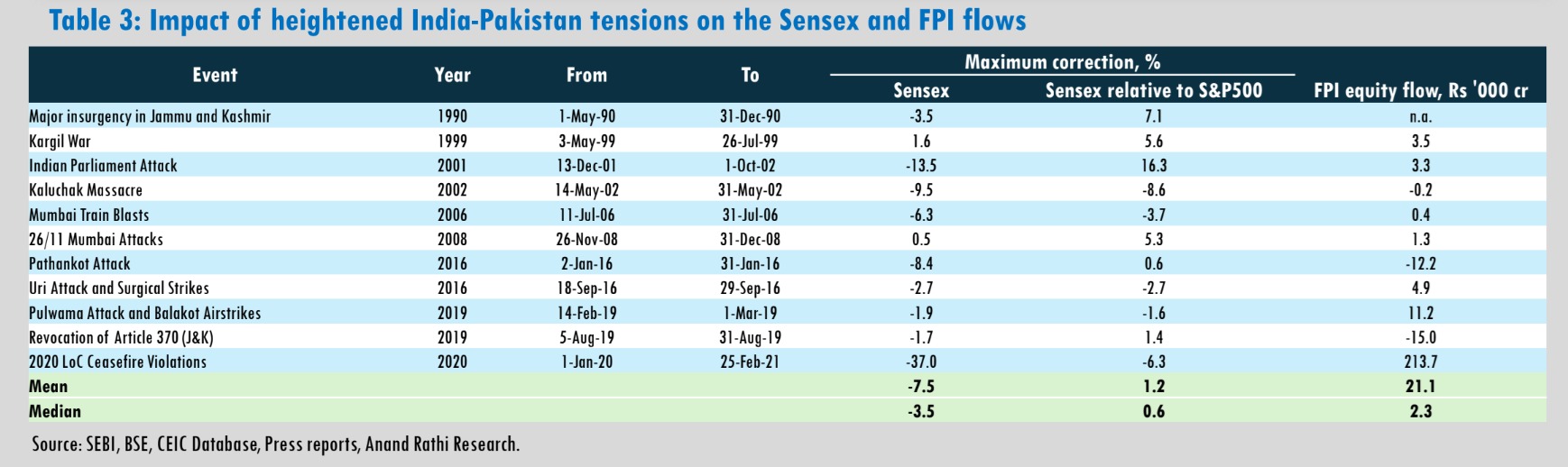
A broader analysis of 11 stressful incidents between India and Pakistan, by Anand Rathi Research, shows that the BSE Sensex fell after eight such incidents. The knee-jerk corrections soon after the incidents, however, ranged from 2 per cent to 9.5 per cent.
CHECK SENSEX ANALYSIS HERE "The average (mean) Sensex correction at lowest points during Indo-Pak tensions was 7.5 per cent and the median, 3.5 per cent. In relative terms (compared to the US' S&P 500), both mean and median were positive, indicating outperformance by India during these periods. FPI flows, also, for the balance, remained positive and turned substantially negative during only two of the 10 episodes," it said in a report.
How will markets react to the India-Pakistan war this time?
Abhishek Jaiswal of Finavenue notes that as long as a full-blown escalation is avoided, India’s economic growth trajectory is unlikely to face any major setbacks.
"In essence, while the initial reaction to cross-border strikes may be cautious, markets tend to recover and even thrive thereafter—reinforcing the idea that political stability, strategic decisiveness, and national security assurance are valued by investors," he said.
Anirudh Garg, Partner & Fund Manager at Invasset PMS concurred and said that military actions involving India and Pakistan raised investor concerns about geopolitical stability in the region.
"Historically, Indian stock markets have reacted sharply in the short-term to such events due to heightened uncertainty and risk-off sentiment. However, past patterns also show that markets often recover swiftly once clarity emerges and broader macroeconomic fundamentals remain intact," he said.
What is Operation Sindoor?
Operation Sindoor, India's "calculated and restricted"
missile attack on nine terror infrastructures in Pakistan and Pakistan Occupied Kashmir (POK), was conducted in the early hours of May 7.
The operation was in response to the Pahalgam terror attack of April 22, 2025, and aimed to eliminate hideouts of terror groups like Jaish-e-Mohammed (JeM), Lashkar-e-Taiba (LeT), and Hizbul Mujahideen (HM).
Following the attack, Pakistan opened heavy firing across several locations along the Line of Control (LoC).

 "Operation Sindoor: How have stock markets reacted to India-Pak war in past?")