Shares of
Central Depository Services (CDSL) came under pressure on Monday, July 28, falling as much as 5.23 per cent to ₹1,530 in intraday trade. The decline followed the company’s disappointing financial performance for the first quarter of FY2025–26 (Q1FY26). While the CDSL stock settled the day at ₹1,524.50 levels, down 5.59 per cent, the
S&P BSE Sensex lost 0.70 per cent to 80,891 levels.
Adding to the pressure was the
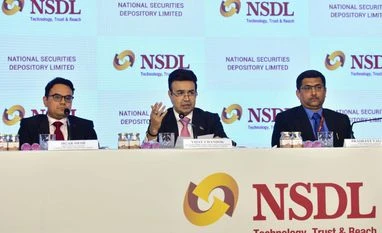
upcoming initial public offering (IPO) of CDSL’s rival, National Securities Depository (NSDL), which is scheduled to open on Wednesday, July 30. Notably, the public issue of NSDL will be an entirely offer-for-sale (OFS) of 50.14 million equity shares, with no fresh capital being raised by the company. The
NSDL IPO is being offered at a price band of ₹760–₹800 per share, with a lot size of 18 shares.
CDSL Q1FY26 earnings disappoint
In its
Q1FY26 earnings report, CDSL posted a 23.73 per cent year-on-year (Y-o-Y) decline in profit attributable to shareholders, down to ₹102.36 crore from ₹134 crore in Q1FY25. Revenue rose marginally by 0.6 per cent Y-o-Y to ₹258.9 crore, compared to ₹257.4 crore in the same quarter last year.
This marks the second consecutive quarter in which the depository has reported a decline in profit. The fall in CDSL's profit during the quarter is attributed to rising expenses and narrowing margins.
ALSO READ | NSDL's ₹4,011-cr IPO opens on July 30: Key risks, strengths you must know Should you sell CDSL shares to invest in NSDL IPO?
The weak results, combined with excitement around the NSDL IPO, have left many investors wondering — should they sell CDSL shares to invest in NSDL, or does the fall present an opportunity to buy them for the long term?
Though the market analysts recommend subscribing to NSDL's IPO citing its attractive pricing and growth potential, they do not advise selling CDSL shares to fund this investment. Both companies, analysts believe, could benefit from continued growth in India's capital markets, especially if the number of Demat accounts continues to rise.
Deepak Jasani, an independent market analyst explains that although both companies operate in the same space, their business models differ. He highlighted that the key determinant of financial and operational performance for both will be the continued growth in the number of depository accounts.
“CDSL has a lower asset base (AUM) but a higher number of depository clients, whereas NSDL has a higher AUM and fewer clients — mostly institutional custodians,” Jasani said. “Because of its larger client base, CDSL trades at a premium. In contrast, NSDL is offering shares at a price lower than the last traded grey market price, which creates investor interest.”
He added that both firms could benefit from the broader growth of retail investors in India. With NSDL going public, the company may also pivot toward expanding its individual investor base under shareholder pressure.
ALSO READ | NSDL IPO opens: Analysts upbeat on fair valuation; should you subscribe? Meanwhile, NSDL primarily serves large institutional clients and handles high-volume transactions. CDSL, on the other hand, focuses on retail investors and has expanded its reach through partnerships with brokers and fintech platforms.
Independent market expert Ambareesh Baliga echoed similar views, recommending a subscription to the NSDL IPO, citing its favourable valuation. Notably, at the upper price band of ₹800, NSDL is valued at 47 times FY25 price-to-earnings (P/E), compared to CDSL, which is trading at 67 times. The IPO price is also nearly 19 per cent lower than the level at which NSDL’s unlisted shares were recently traded.
He also points out the uncertainty regarding IPO allotment. Notably, all applicants receive full allotment only if the issue is fully subscribed or undersubscribed. However, in the more likely case of oversubscription, allotment is done via a lottery or pro-rata system, which, Baliga said, adds an element of unpredictability.
“The IPO offers a good opportunity, but that does not mean investors should sell CDSL shares to participate,” advises Baliga.