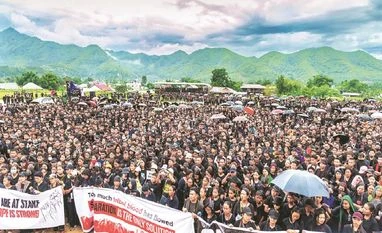
The Bharatiya Janata Party (BJP) government under Chief Minister N Biren Singh in Manipur, and by implication, the party nationally, and the Modi government are all under attack over continuing anarchy in the state. In fact, a more apt description now would be “civil war”. Its defenders make their case on three arguments:
*The state was never peaceful. If anything, the BJP has given it six years of relative peace. It was the Congress that divided the communities (ethnicities) over the decades. It can’t be set right so soon.
**There is a larger, foreign-inspired conspiracy behind the continuing violence. Why did the video that shamed and shook the nation, for example, become public 10 weeks after the incident? It was obviously timed to coincide with the beginning of Parliament’s monsoon session.
***This isn’t said explicitly, but implied broadly. Also, this is central to the social media counterattack by the BJP warriors. That the largely Hindu Meiteis are under attack from Christian Kukis and the church is playing a central role in the crisis. What’s been said, openly, including by Chief Minister Singh, is that too many “foreign” (Myanmarese Kukis) are involved, there is foreign (Chinese, he insinuated) hand, and that the Kuki tribals are forest encroachers, illicit poppy growers, drug smugglers and terrorists. “Terrorist” is an expression he has used for them more than once and it’s been widely reported in the national broadsheets.
Even as we reel and recoil under this national shame at the surfacing of the video, baring our ugliest reality, we need to take a deep breath and calmly put these propositions to the test of facts, logic and history.
First of all, the BJP is absolutely right to say that the state was never really fully normal, at least not since the mid-1970s. There were spells of political instability under the Congress, insurgencies, terrorism and inter-ethnic strife. Today, it is the Meiteis and Kukis at war with each other. In the past, it was Kukis versus the Nagas who, in turn, were at war with the Indian state. Remember that the chief of the National Socialist Council of Nagaland (NSCN), T Muivah, is from Manipur.
The BJP is right to say that they did inherit a troubled and deeply divided state from the Congress. Which is also the reason the people of the state embraced them as a new political power to check out. But, if the Congress had made a series of errors through the years, the BJP should have given the people real change. Instead, they borrowed their key leadership in the state from the same Congress they call discredited. These names include Biren Singh.
Instead of bringing about a substantive change in the political style and approach, the BJP government also persisted with their same policy of divisiveness. To understand how divisive, we need to track a series of statements made by the chief minister in the weeks leading up to the flare-up, and even during its course.
I am jumping chronology a bit by beginning with what he said on June 20, instead of many earlier utterances and signals. On June 20, seven weeks after the rapes and killings and while the civil war still raged, he said: “These acts must stop. Mainly the SOO (Suspension of Operations) Kuki militants should stop it, otherwise they will face the consequences. I also appeal to Meitei people, who are with arms, not to do anything illegal.”
Now read this carefully, both sides are armed, but he calls one “militants” and threatens them. And appeals to his own who are armed, not to do anything illegal. No threat of consequences for them.
If you still aren’t convinced this was divisive, check out his statement from May 29, again widely published, including in The Indian Express: “We have launched ops against terrorists who have been attacking civilians using sophisticated weapons like M-16, AK-47, sniper (rifles)…” Who he’s calling “terrorists” is not left in doubt by a series of other statements.
More than once in tweets (now deleted), he responded to Kuki critics calling them Myanmarese. To one who reminded him that Meiteis also live in Myanmar, he responded by saying but they do not demand their own homeland in that country. Insinuation being that the Kukis are doing so in India.
Not confining himself to Myanmar (which is a friendly government for India), on July 1, he brought in China as well. “Foreign hand can’t be ruled out… there is China nearby,” he said.
There is more than sufficient evidence, therefore, to show that if the Congress in the past might have divided the state ethnically with its politics, the BJP was doing nothing different now.
The rest, the tendency to view this in Hindu-Christian terms or finding the dark shadow of the church somewhere is rooted in the essential BJP ideology, particularly in a conflict where none of the antagonists is Hindu. From Assam and Meghalaya (on CAA-NRC), to Manipur now, this simplistic binary has failed the test of the complexities of the Northeast.
Identity — religion, caste, ethnicity, language, region — is supremely important in any part of the country. In the Northeast, however, the determinants of identity are way more numerous, complex and convoluted. The Nagas, for example, are one broad group but consist of 28-35 distinct tribes (depending on who is counting), with their own languages, culture and history of warfare in the past. In Assam, the BJP embraces some Muslims (the natives) but wants others (Bengali-speaking immigrants) out based on CAA-NRC. They’d use the same laws to retain Hindus, even if proven foreigners.
The Assamese who campaigned for decades to get all “foreigners” out won’t make that Hindu-Muslim distinction.
The central lesson is that the formulations on identity that might work in larger parts of the country do not apply in the Northeast. If you try to paint it with the same brush, you get a humiliating retreat as in Assam (which led to sizeable protests in Meghalaya, too), or what we are now seeing in Manipur.
Manipur, in fact, is the state that defeats this Hindus-as-nationalists-by-default binary completely. While the insurgencies in neighbouring Nagaland and Mizoram were carried out by Christian tribes and often had the church helping them, the only substantive rebels in Manipur have been Meitei Hindus.
In the late 1970s, two armed forces emerged. The first and the most important, People’s Liberation Army (PLA), was led by Nameirakpam Bisheshwar Singh, who went to Lhasa for training and arms and returned with his 18 “comrades” in 1978 to start a “revolutionary” war. He was captured in the famous Tekcham clash by the Army’s (then) second Lieutenant Cyrus Addie Pithawalla of 17 JAK Rifles. He won an Ashok Chakra (our highest peacetime gallantry award) for this action and Bisheshwar, later released, became a politician. His successor, Kunjabihari, was killed in 1985 in another clash with the Army in Kodompokpi in 1985.
The other group, PREPAK (People’s Revolutionary Army of Kangleipak), was led by R K Tulachandra Singh and like the PLA, also professed communism. Tulachandra was killed by the Army in 1985 as well. In the wake of these two dying organisations rose many factions (at last count, a dozen) of Kangleipak Communist Party (KCP). Kangleipak is an ancient name for Manipur (the plains region).
Importantly, all of these groups were fully Meitei and Hindu. If anything, the tribals were out of the fight through these decades. I mention this here, and in such detail, only to remind us all of the reality of the Northeast. That the region is complex, unique, challenging and nothing is guaranteed to fail more spectacularly than the idea that you could govern it by employing any Hindi heartland kind of binaries we might be more familiar with. The broken Manipur today is evidence of that.
By special arrangement with ThePrint