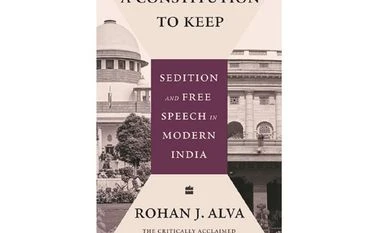
A Constitution to Keep: Sedition and Free Speech in Modern India
Author: Rohan J Alva
Publisher: Harper Collins
Pages: 370
Price: Rs 699
“Every member of the public who censures the ruler for the time being exercises in his own person the right which belongs to the whole of which he forms a part. He is finding fault with his servant….To those who hold this view fully and carry it out to all its consequences there can be no such offence of sedition.”
In other words, in a true democracy there can be no question of punishing people who air their grievances against the government. Sir James Fitzjames Stephen, the author of the quote above, was, interestingly, the architect of Section 124A of the Indian Penal Code, 1860, which defines and punishes sedition.
But these lofty, noble ideas were not available for the “jewel in the crown” as this colony could not be lost to pernicious ideas such as “self-determination”, “liberty”, or “freedom”. Thus it made sense to stifle free speech, especially political speech, in colonial India.
However, when the Constitution of India guarantees to its citizens the freedom of speech and expression as a fundamental right, why does Section 124A, inserted in order to protect repressive colonial rule, remain as a part of the Penal Code?
It is this debate that Rohan J Alva delves into in his extremely well-researched book taking the reader through an almost rollercoaster ride, showing that legal history can sometimes be almost a potboiler, with unexpected twists and turns. Tracing the history of sedition from the Gagging Act of 1857, and ending (for the time being) in the provisions of the Unlawful Activities (Prevention) Act, Mr Alva goes into the history of Section 124A of the Penal Code, its relationship with Article 19(1)(a) of the Constitution, the debate over sedition as a restriction on free speech as discussed in the Constituent Assembly, and the eventual emergence of sedition as a reasonable restriction to the fundamental right of free speech and expression in independent India.
While taking us on this journey, he points out that sedition, as defined in Section 124A of the Indian Penal Code, 1860, had been pejoratively designated as “the prince” among the political sections of the Penal Code by Mahatma Gandhi.
One would have expected that this “prince” would have no place in an independent India, but as the author shows, the prince, while exiled for a short time, returned triumphantly and now rules as a cruel and draconian King.
In the original Constitution, the only restrictions on the right to freedom of speech and expression, as enumerated in Article 19(2), were laws relating to libel, slander, defamation, contempt of court or matters which offended decency or morality, or which undermined the security of the state or which tended to overthrow the state. The core words of Section 124A “hatred” “contempt” or “exciting disaffection” or indeed the word “sedition”, were deliberately not used, thus effectively sounding the death knell of Section 124A.
The book then goes on to show how, in the fledgling days of our republic, the Supreme Court held that “…without free political discussion no public education, so essential for the proper functioning of the processes of popular Government, is possible...”, and with specific reference to Section 124A, said “..so long as the possibility of it being applied for purposes not sanctioned by the Constitution cannot be ruled out, it must be held to be wholly unconstitutional and void.” For those living through this period, it would have seemed that Section 124A was almost ready for its last rites.
As the book goes on to narrate, the First Amendment wrought by Parliament, and the subsequent decisions of the Supreme Court, starting from the decision in the Kedar Nath Singh case, brought legitimacy to Section 124A, rolling back all the good intentions of the founding fathers of our republic.
As the author points out, even though the Supreme Court in the Kedar Nath Singh judgment, attempted to build in a safeguard by holding that no one would be prosecuted for sedition unless they threatened public order, history has shown that these safeguards have been a monumentally abysmal failure, leading to a dilution and diminution of the fundamental right to free speech and expression, especially in the political arena.
In the natural order of things, Kings die. And it is time to bury this one as the founding fathers of our Constitution wanted to. The Supreme Court has recently directed the government not to register any new cases under Section 124A, till the law is reviewed. This, according to the author, may be a Pyrrhic victory, as the even more stringent provisions of the UAPA continue to treat sedition as a crime. Only time will tell whether the phrase, commonly misattributed to Voltaire, “I disapprove of everything you say, but will defend to death your right to say it”, will ever be true for India. To quote Mr Alva from the last sentence of this must-read book, “To quell the voice of the people using the hammer of sedition ought to be treated as a constitutional sin.”
The reviewer is a lawyer practising in Delhi