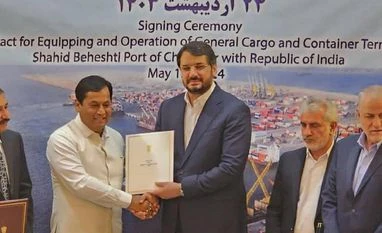
The signing of the Long Term Bilateral Contract on Chabahar Port Operations in presence of HE Mehrdad Bazrpash, Minister of Roads & Urban Development, Iran & India's Minister of Ports, Shipping and Waterways Sarbananda Sonowal | Photo: X/ @sarbanands
3 min read Last Updated : May 14 2024 | 10:24 PM IST
More than two decades after the project was conceived under the Atal Bihari Vajpayee government and almost eight years after the Narendra Modi government signed an agreement to establish an International Transport and Transit Corridor at Chabahar, India and Iran finally signed a 10-year operational contract on Monday. The agreement, between Indian government-owned India Ports Global Ltd (IPGL) and Ports and Maritime Organisation (PMO) of Iran, commits the former to invest roughly $120 million to equip and operate the port. A rupee credit window of $250 million to augment infrastructure is also on the table. The immediate significance of the agreement is that it breaks a six-year deadlock on equipment sourcing. Suppliers had been reluctant to open letters of credit on IPGL for fear of United States sanctions on Iran. Under the new deal, PMO will procure equipment on behalf of IPGL and the money will be refunded to an Iranian entity based in the United Arab Emirates. This development follows an agreement in April between India and Myanmar for IPGL to take full operational control of Sittwe Port to enhance connectivity between Myanmar and India’s Northeast.
The Chabahar project is considered a response of sorts by India to China’s massive Belt and Road Initiative (BRI). Even if that is overstated, its importance to New Delhi can be seen from the fact that Sarbananda Sonowal, minister for shipping, ports and waterways, flew to Tehran in the middle of parliamentary elections to sign the agreement. The Shahid Beheshti port, to give Chabahar its full name, is seen as a key competing hub to Gwadar, the port that China is developing in Pakistan, offering India connectivity with Afghanistan and Central Asia by skirting its troubled western neighbour. Enhancing its potential is the prospect of linking with the International North South Transport Corridor (INSTC), a joint project by India, Russia, and Iran, to link the Indian Ocean and the Persian Gulf via an overland multi-modal corridor to St Petersburg and northern Europe. Chabahar was considered critical enough for the Modi government to secure a waiver from the US administration when Donald Trump was president, citing access to Afghanistan as a reason. But with the US disengaged from Afghanistan, the Biden administration has issued an oblique warning that anyone doing deals with Iran risked the threat of sanctions. This will be a diplomatic challenge for the Indian government.
As with Sittwe, where civil war in Myanmar is stalling progress, the political turbulence of the region means that operating the Chabahar port will be fraught. It is located in the Sistan-Balochistan region, sharing a border with Afghanistan and Pakistan, where a long-running insurgency festers. In January this year, Iran launched missile strikes into Pakistan’s Balochistan province, ostensibly to flush out anti-Iranian militants, to which Islamabad responded with missiles and fighter jets in Sistan-Balochistan apparently to wipe out anti-Pakistani insurgents. Russia’s war with Ukraine is also likely to weaken the ambitious INSTC adjunct. But the more substantive gain from the Chabahar agreement is geopolitical. At a time when India has been seen as tacitly backing Israel in its war against Hamas, including a deal sending Indian workers to Israel to replace Palestinians, the Chabahar agreement provides an opportunity to apply a rebalance to New Delhi’s West Asian relations. Given the current uncertainty in the region and India’s deep dependence on it, this, too, is an invaluable gain.