Sri Lanka’s newly elected President Anura Kumara Dissanayake’s choice of India for his first overseas visit signals a positive dynamic in ties between the two countries. Mr Dissanayake, who heads the Marxist-leaning Janatha Vimukthi Peramuna (JVP), the senior partner in the ruling National People’s Power coalition, was seen as ideologically leaning towards China. Beijing already wields considerable power over the island-nation’s political economy as its biggest bilateral lender and a top source of foreign direct investment. At the same time, the JVP has been anti-Indian, having led the opposition, often violent, to Indian intervention in Sri Lanka in the late 1980s after accords saw the introduction of Indian soldiers in the Sri Lankan civil war with the Tamil separatists. With the emergence of China’s aggressive Mission Indian Ocean, which targets India, New Delhi’s concerns had multiplied. On Monday, statements from Mr Dissanayake assured India that he would not allow Sri Lankan territory to be used in a way that would be detrimental to India’s interests. This was reflected in an emollient joint statement that spoke of the two countries’ shared security interests and the need for regular dialogue based on mutual trust and transparency.
These assurances are significant in the context of China’s presence in Hambantota port, which it has leased for 99 years after Sri Lanka defaulted on a loan for the development of the port. Located in southern Sri Lanka, Hambantota is the country’s second-largest deepwater port, just 535 nautical miles from Chennai. China’s presence here is considered an example of how Beijing uses loans to build a strategic presence. The menacing potential of this presence was demonstrated in 2022, when a Chinese satellite- and missile-tracking ship docked there. On Monday, India’s foreign secretary clarified that Mr Dissanayake’s statement could be an indicator of Sri Lanka’s clearance for foreign research vessels docking at its ports, on which Colombo had imposed a moratorium since January this year. Mr Dissanayake’s statement, therefore, is seen as a strong signal that his regime would play, at the very least, a pragmatic geo-strategic balancing act. His inclination for doing so may be rooted in gratitude for India’s help in riding out its economic crisis with $4 billion worth of aid and support towards securing a bailout from the International Monetary Fund (IMF). More assistance has been discussed for infrastructure projects such as railway signalling systems and energy projects to rebuild its shattered economy.
Some issues remain to be sorted. Among them is the long-standing 13th amendment to the Sri Lankan Constitution, devolving some powers to the Tamil provinces, which the JVP had fiercely opposed in 1987. It is possible that relations between Mr Dissanayake’s party and the Tamil minorities may have changed, given that the east and north also voted in large numbers for his coalition. Also hanging fire is the possible cancellation, which he had promised, on environmental grounds of an Adani wind-power project. It is worth noting that this is Mr Dissanayake’s second visit to India in 10 months. Though Indo-Sri Lankan relations look set to revert to a mutually beneficial template, much will depend on how successfully Mr Dissanayake negotiates his country’s IMF and bond-holder obligations with his welfarist poll promises and fashions his relations with China, the country’s largest creditor.

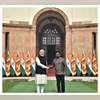 "Dissanayake's India visit marks positive shift in Sri Lanka's foreign ties")









