Themeless election

India needs a positive agenda

election,vote,voting,election 2024,lok sabha voting
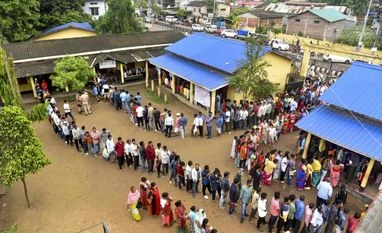
Representative image
Business Standard Editorial Comment
3 min read Last Updated : May 07 2024 | 10:01 PM IST
It has been over 50 days since the Election Commission of India announced the Lok Sabha election and the Model Code of Conduct came into force. Three phases of voting have concluded, with voters in over half the Lok Sabha constituencies having exercised their franchise. While both the ruling National Democratic Alliance, led by the Bharatiya Janata Party (BJP), and the Opposition bloc, with the Congress as its largest constituent, are campaigning to improve their chances, what voters are missing is a substantive debate on crucial issues. To be sure, both parties have released their manifestos, but they are not necessarily the main talking points. And, in any case, campaigning in India is much more than manifestos. What India instead has are debates on mostly irrelevant and often undesirable issues. An electorate that would soon be running the world’s third-largest economy was expecting better. Since the focus is not on substantive issues, the language has also been a casualty.

This is in sharp contrast to the Lok Sabha election 10 years ago. The BJP capitalised on the weaknesses of the United Progressive Alliance government with the promise of “achhe din”. It was a positive campaign for change and delivered a single-party majority after decades. The 2019 election was dominated by the national-security theme, with Pulwama and Balakot forming the backdrop. Nothing of that sort is visible today. The campaign thus far has moved around history — sometimes medieval history — who ate what and when, preserving or increasing reservations — often pitting one section of the population against another — and redistributing wealth and resources, among others. None of these will help increase, say, the pace of economic growth or improve learning outcomes in schools. The issue of inheritance tax, for instance, became a debating point for no reason for a few days and faded away. It is well known that imposing and administering such a tax will be enormously difficult in India.

One of the reasons why political parties end up talking about irrelevant issues could be a long election cycle. Completing the process in two or three phases would have perhaps kept them more focused on important matters. The primary responsibility for improving the political discourse rests with both the BJP and Congress. For the BJP, which aims to make India a developed nation, it was an opportunity to show its achievement and campaign on the future road map. For the Congress and the Opposition at large, it was a chance to highlight areas where the government could not make an impact and present a better alternative in front of voters. Unfortunately, none of these are happening. Indian voters are largely getting to hear personalised attacks and issues that are unlikely to take India forward.

What India needs is rapid economic development. Political capital and energy thus should be focused on enabling sustainable higher growth. A related issue in this context is employment generation. India needs to generate productive employment for its rising workforce and to pull people out of agriculture, which still engages nearly half the workforce, to increase productivity and growth. How India can achieve such goals should be a major feature of any policy or political debate. A pre-poll survey by the Centre for the Study of Developing Societies showed inflation and employment were the biggest concerns for the majority of Indians. It’s time for the political debate to pivot towards issues directly affecting people’s lives.

One subscription. Two world-class reads.

Already subscribed? Log in

Subscribe to read the full story →
*Subscribe to Business Standard digital and get complimentary access to The New York Times

Smart Quarterly

₹900

3 Months

₹300/Month

SAVE 25%

Smart Essential

₹2,700

1 Year

₹225/Month

SAVE 46%
*Complimentary New York Times access for the 2nd year will be given after 12 months

Super Saver

₹3,900

2 Years

₹162/Month

Subscribe

Renews automatically, cancel anytime

Here’s what’s included in our digital subscription plans

Exclusive premium stories online

  • Over 30 premium stories daily, handpicked by our editors

Complimentary Access to The New York Times

  • News, Games, Cooking, Audio, Wirecutter & The Athletic

Business Standard Epaper

  • Digital replica of our daily newspaper — with options to read, save, and share

Curated Newsletters

  • Insights on markets, finance, politics, tech, and more delivered to your inbox

Market Analysis & Investment Insights

  • In-depth market analysis & insights with access to The Smart Investor

Archives

  • Repository of articles and publications dating back to 1997

Ad-free Reading

  • Uninterrupted reading experience with no advertisements

Seamless Access Across All Devices

  • Access Business Standard across devices — mobile, tablet, or PC, via web or app

Topics :Election Commission of IndiaLok Sabha electionsBusiness Standard Editorial CommentNational Democratic Alliance

Next Story




