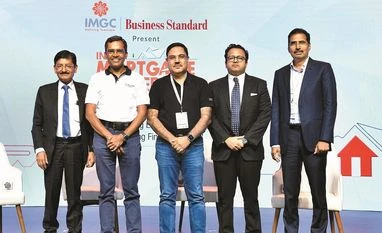
Heads of India’s leading housing finance companies met at Business Standard India Mortgage Leadership Conclave 2024 to discuss ‘Housing for All — How Affordable is Affordable Housing?’ The panel included T Adhikari, MD & CEO, LIC Housing Finance; Jairam Sridharan, MD, Piramal Capital & Housing Finance; Lakshminarayanan Duraiswamy, MD, Sundaram Home Finance; Ravi Subramanian, MD & CEO, Shriram Housing Finance; and Shantanu Rege, MD & CEO, Mahindra Home Finance. Edited excerpts:
Is there a need for a re-look at the definition of affordable housing, which is Rs 45 lakh per unit?
Adhikari: I believe there is a need to re-look at the definition of affordable housing with the current Rs 45 lakh cap and specific carpet area limits. The fixed amount is impractical for major urban centres like Mumbai, where the upper limit for area is 60 square meters. Post-Covid, the demand for larger spaces in Mumbai raises concerns about the adequacy of the Rs 45 lakh value. I propose a government review focusing on defining dwelling unit size to ensure fairness, particularly for economically-weaker sections (EWS), lower-income groups (LIGs), and middle-income groups (MIGs) under the Credit-Linked Subsidy Scheme (CLSS). Restricting criteria to dwelling unit size, irrespective of cost, would better serve the intended demographic.
Do you think another version of CLSS, as in CLSS 2.0 is required at this point in time to boost affordable housing?
Duraiswamy: The success of CLSS was mainly due to the incentives it offered rather than its initial structural design. However, the scheme’s complications, particularly in determining whether a specific house or project qualifies for CLSS, were based on its pin code. While a scheme 2.0 is anticipated, it should fundamentally address the drivers for encouraging affordable housing rather than relying solely on monetary incentives.
The finance minister said that the aim is to add 20 million houses in the next five years. What is your view? What are the main challenges in doing so? And, do you think the budgetary allocation for this is sufficient?
Rege: There’s much discussion about CLSS and Pradhan Mantri Aawas Yojana Urban (PMAYU). Currently, the ongoing Pradhan Mantri Aawas Yojana Grameen (PMAYG) offers staged financial assistance of around Rs 1.2-1.5 lakh for the kutcha to pucca transformation. This scheme positions the government as a housing financier, providing financial support for the transformation process. The decision on the economic viability, involvement of private financiers, and the government’s role as a societal good provider is for the government to determine. As housing financiers, our role is to encourage such initiatives.
In case the government comes up with CLSS 2.0, what will be your suggestion and feedback in terms of contours of the scheme?
Adhikari: Advising the government on CLSS is challenging. The Budget allocates around Rs 76,000 crore, with Rs 54,000 crore for PMAY Grameen, leaving approximately Rs 22,000 crore for PMAY Urban, which may be insufficient given the demand. The cost of finance to housing companies is a concern, considering the inherent risks in the industry. The industry needs to account for risk costs and decide on lending rates and passing on lower finance costs to borrowers. The complex definitions, such as EWS, LIG, MIG1, MIG2, and pin code qualifications, need simplification for inclusivity. While subsidies are beneficial, the government should focus on making the scheme more accessible to the ‘have-nots’ rather than the ‘haves’. There’s a need for a clear and simplified approach, ensuring that the intended beneficiaries benefit from the scheme.
Subramanian: Two crucial aspects need attention. Firstly, despite the scheme's societal impact, there have been instances where individuals from the upper classes, not belonging to EWS or LIG, benefited due to unscrupulous housing finance practices. Addressing this gap is essential to ensure that the benefits reach the intended demographic. Secondly, the process needs simplification both in claiming and administration compared to the current complexities. These measures are vital for the effective implementation of the scheme.
Many companies operate in certain geographies. So, do you think we really need to scale up our efforts to ensure housing for all? What amount of the finances reaches Tier-III and -IV cities?
Subramanian: Affordable housing finance companies in India are uniformly profitable, despite lending to customers at relatively high interest rates of around 14 per cent. They typically borrow from the market at lower rates, leading to healthy margins. With low levels of non-performing assets and credit costs, affordable housing finance stands out as the most profitable segment in the housing finance sector. However, achieving scalability remains a challenge, particularly in Tier-II and -III cities. Investment over a prolonged period, around 10-15 years, is necessary to realise scalable outcomes.
Does it remain affordable if the interest rate is 14-15 per cent?
Subramanian: Many housing finance company chiefs need to justify why they charge interest rates as high as 14-15 per cent when customers may struggle to afford them. Despite the high rates, the relatively low loan amounts, typically around Rs 10-11 lakh, have a minimal impact on the equated monthly instalment (EMI). Increasing the loan amount slightly, such as from Rs 8 lakh to Rs 9.5 lakh, can significantly impact the customer’s ability to repay. While some companies may charge excessively high interest rates, most charge within the range of 12-13.5 per cent, which is deemed acceptable in terms of affordability.
How do you ensure ‘housing for all’ if you don’t penetrate in Tier-III and -IV cities?
Sridharan: Scaling affordable housing finance to a significant size, such as achieving a Rs 2 trillion assets under management (AUM), is deemed infeasible due to the current regulatory and cost-profitability dynamics. The prevailing business model, focusing on smaller loans at interest rates of 11-13 per cent, poses challenges in achieving substantial growth. The trend is towards creating small, niche entities that remain profitable within their limitations. The shift away from large housing finance companies, exemplified by HDFC, indicates a broader industry trend. This suggests that the future may not see large housing finance entities, and scaling up affordable housing finance to such levels seems unlikely. This suggests the need for either a proliferation of smaller finance companies or a re-evaluation of penetration strategies.
Subramanian: Structural issues in housing finance companies, particularly with private equity (PE) ownership, pose challenges to scaling up. PE-owned companies typically operate with short-term horizons, which complicate long-term growth strategies. Balancing scalability and profitability is a struggle for many affordable housing finance companies, as scaling up incurs higher costs that can impact profitability and PE valuations negatively. However, scaling up is feasible with sustained investment and focus, as demonstrated by established firms like LIC Housing Finance and Shriram Finance. Despite the market being crowded, the vast potential of the affordable housing segment remains untapped, with ample room for growth. While there is ample room for growth, challenges persist in accessing talent and investing in Tier-II and-III cities.
What is your prescription for ‘housing for all’ and how do we achieve that?
Adhikari: We must acknowledge that affordable housing has been overlooked in favour of more lucrative markets catering to salaried individuals. To rectify this, the government should consider offering concessions to incentivise investment in affordable housing. However, we must proceed cautiously and prudently. Despite a growing inventory in the semi-luxury and luxury segments, there’s a noticeable lack of interest from top builders in affordable housing. Adani’s involvement, facilitated by government schemes like slum rehabilitation, highlights the potential for development in this sector.