Home / Specials / BS Events / India's agri, labour reforms key to growth amid global shifts: Suman Bery
India's agri, labour reforms key to growth amid global shifts: Suman Bery
Niti Aayog's Suman Bery highlighted the need for agricultural reforms, labour formalisation, and increased women workforce participation to sustain India's growth amid shifting global dynamics
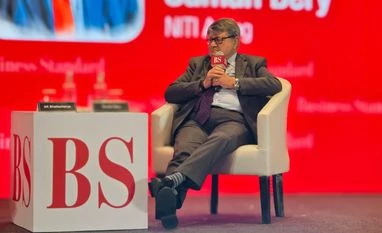
Niti Aayog Vice Chairperson Suman Bery speaking at Business Standard’s annual event BS Manthan on February 28, 2025.
4 min read Last Updated : Feb 28 2025 | 7:15 PM IST
The transformation of India’s agriculture and labour sectors is central to the country’s economic growth amid global shifts, according to Niti Aayog Vice Chairperson Suman Bery. In a fireside chat themed 'The Great Reset: India in a New World Order' at Business Standard’s annual event BS Manthan on February 28, Bery emphasised the need for structural reforms to modernise agriculture and integrate more women into the workforce.
Bery described India as an "agri tiger" with untapped potential. "We need to be unleashed, but we are stuck," he said, noting that while the existing agricultural model prevented food shortages, it now requires evolution. He called for placing horticulture and crop farming on equal footing to improve productivity and efficiency.
On labour, Bery stressed the importance of formalisation. "Formalisation of labour contracts and the workforce is important, and it's probably the labour laws that make medium and large scale enterprises shy of hiring labour," he said, referring to global studies on employment structures.
Bery also highlighted the necessity of increasing women's participation in the labour force. "Our most underutilised resource is women. The Prime Minister has focused on this from the beginning, and there has been progress in women labour force participation," he said.
Maintaining the unity of India’s labour market was another key concern. Bery highlighted the importance of ensuring seamless labour mobility across states, even for seasonal migration, to balance the country’s diverse demographic trends.
Global financial stability a must for growth
Discussing global economic shifts, Bery acknowledged the impact of US policies on trade and tariffs. He noted that while India had traditionally adhered to World Trade Organisation (WTO) rules, recent developments had forced it to reassess its position. "If what we want is 7 per cent growth, lower tariffs are one way of achieving that," he said.
Bery also pointed out that investment conditions in India needed improvement. "We need to enhance the investment climate for both domestic and foreign investors," he said, adding that trade agreements should be structured to maximise India’s benefits.
On climate and energy, Bery highlighted financing challenges in India’s transition towards sustainable energy. "The real issue is the fiscal challenge of financing adaptation while maintaining growth," he said. The Niti Aayog Vice Chairperson noted that state governments were increasingly taking independent initiatives in urban and labour reforms, requiring a coordinated approach at the national level.
Bery also addressed the changing global power structure, particularly US-China-Russia relations. “The US, at the time of Kissinger, thought that driving a wedge between Russia and China was important. Equally today, it is in India’s interest that Russia be freed from the Chinese embrace. That is a possible consequence of the replacement of the Biden admin by Trump admin,” he said.
Addressing a query on how diverse and complex is this global reset, Bery invoked examples from history, with the establishment of the dominance of the US post second world war. “The story begins with the US as the dominant power after the second world war. For whatever reason, they created a set of institutions (the UN, the World Bank, IMF etc). Let’s be clear, anytime this did not suit them, they felt able to change. Example being Nixon going off the Bretton woods system," Bery said.
"Second was when Japan was dragged to the Plaza Accord. US treatment of the WTO. The notion that the US has the privilege to reshape the rules of the game to suit itself, is not unusual. What is intriguing is why the US feels beleaguered at this time. There is American exceptionalism in tech, market, growth and productivity,” he remarked.


 "India's agri, labour reforms key to growth amid global shifts: Suman Bery")

