A monumental 16-foot by 22-foot door welcomes you into Chaand Bagh, the home of Raseel Gujral Ansal, tucked away in the verdant green belt of Jaunapur in South Delhi. Nestled within the city yet blissfully insulated from its chaos, the estate lives up to its name — ‘Moon Garden’ — with the crescent crowning each of its five domes that seamlessly blend with the many architectural influences the home embraces.
The grand wooden door, which weighs a tonne, is replicated from a series by her father, the celebrated painter, sculptor, muralist and Padma Vibhushan awardee, Satish Gujral. Overlooking it from across the porch is a sculpture, titled Trinity (2017), which he had gifted her when she completed 30 years in the world of interior design. “It’s a man on a unicycle,” she says — a reflection on life, death, and rebirth. She elevated it, and placed it on a podium, turning it into a homage to her father.
Chaand Bagh is an ode to Satish Gujral, with his artworks adorning practically every room. The expression, though, is Raseel’s — ornate and grand, but without losing the sense of space. It begins at the entrance, where the porch ceiling, inlaid with glass, catches fragmented reflections of those beneath it, evoking a Mughal-e-Azam-like romance.
(clockwise from top-left) Indonesian chair, with symbols of divinity, sits at the head of the living room; Trinity, a sculpture by Satish Gujral, overlooks the main door; the octagonal dining room
The home, which Raseel has shared with her husband, Navin Ansal, for the last 14 years, sprawls across two-and-a-half acres and is an arresting blend of Indo-Saracenic architecture — where Indian, Islamic, and European elements fuse effortlessly — with colonial and contemporary flourishes.
Her philosophy is: “What you live in, you become.” Walking through the house one notices the absence of doors. “I prefer an open flow,” she says. “My lifestyle is open. I don’t like to be closed in boxes. The outside must flow in, and vice-versa.” So the walls simply hold the space — they don’t restrict it.
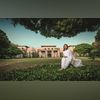
Dressed in white, with silver elephant bangles gleaming on her wrists, Raseel recalls her unconventional education. “When I began working in architecture in 1986, I was unschooled.” Her father taught her abstractly, with the freedom to move across disciplines — interiors, product design, graphic design, architecture. That fluidity finds expression in her home, with the foyer leading into a larger space, which then flows into the living room, at the head of which is an ornate Indonesian chair with symbols of divinity — Laxmi charan (feet) and Nandi.
The living room opens into a lush lawn where Gomi Bakain (Persian lilac) trees form a natural canopy. These trees are native to Ferozepur, Punjab, where her husband grew up. “He insisted I plant one,” says Raseel. “It grew so beautifully and quickly, like a chhatri (canopy)”, that she planted them all around, and ended up creating a lawn that looks like a Pichwai painting.
Beyond the lawn is a 70-ft by 30-ft pool, dotted with hollyhocks and with a sculpture of a baby elephant. Inside, large plantation fans and a 30-foot-high ceiling lend the space a breezy, resort-like atmosphere.
Facing east, the house has 24-inch-thick walls that insulate it against Delhi’s extremes. It has two floors — the upper one housing bedrooms and guest suites. “I didn’t want a basement, just large, functional rooms, and lots of cupboards,” she says. “My father used to say: Build a home the way a bird builds a nest, shaped to its body.”
(clockwise from top-left) the hallway, living room and corridors are doorless, giving a sense of openness; big cats occupy the walls of another living room; the airy bedroom also has plantation fans
In Raseel’s “den”, a painting by Farhad Hussain titled Money, Money, Money hangs on a wall, which also has a cherished piece by her father titled Nancy. He painted it in 1954 during his time in Mexico, where he studied at the Palacio de Bellas Artes. “It is from his Deity Series, which isn’t widely seen,” she says. Other artworks — Garuda, Pichwai, and depictions of modern-day strife and spiritual reflection — span four decades of collecting.
Among the paintings displayed across the home is her father’s self-portrait, which he gifted her on her 50th birthday, and a painting by him of her mother, Kiran Gujral. They anchor the emotional gravity of the space.
Scattered throughout the house are also subtle temple-like corners featuring silver deities and curated family photographs chronicling a life steeped in art, memory, and soul.
There are collectibles everywhere one looks — in the curved, tiger-shaped chairs, in the wall clock collection that shows the time from around the world, in the elaborately framed mirror in her powder room…
(clockwise from top-left) a powder room flooded with natural light; another ornate powder room; Raseel Gujral Ansal’s den is rich with artworks
For Raseel, luxury is not defined by its price. On her dining table, for instance, are “cheap and cheerful” whimsical owl decorations, once used as Christmas ornaments. “They’re also Laxmi’s vahan (vehicle),” she says. “I love beauty. I buy what speaks to me; it doesn’t matter if it is expensive or from the street.”
Her design journey began organically, and she learnt everything from woodwork to electricals. In 1993, she and Navin Ansal launched their own venture, Paradox, later rebranded Casa Paradox to signify “home”. One of her early clients was Richard Streiter, the first dean of the National Institute of Fashion Technology. She began by designing furniture at a time when customised options were scarce, and gradually expanded into interiors. “I understood fashion and wanted furniture to be presented as a collection,” she says.
Chaand Bagh, which took 21 months to complete, is a distillation of that philosophy. Every element bears her imprint — from the Delhi Sultanate-inspired columns and jaalis to the long corridors and gently tweaked domes. “My domes are semi-detached — a twist to my father’s style,” she says. Their ceilings have lattice work and are beautifully painted, one of them with colourful butterflies.
Raseel believes in linear design over blocky construction and uses 3D models with inserted images to finetune every decision. “A home must reflect you — that’s its soul,” she says. “Design it around your habits.”
Satish Gujral’s passing at 93 left a deep void. “He was still working — finishing two artworks 10 x 8 feet in size,” she recalls. “I loved his Partition series, but I’m also drawn to his Icons series — gilded, restrained, with negative space. He made about 25; 18 are still with us.”
In every dome, corridor, and corner of Chaand Bagh, that legacy lives on — not as an echo of the past, but as a vibrant, evolving inheritance.
Photos: Priyanka Parashar, Prateek Mishra, & courtesy Raseel Gujral Ansal

 "The fine art of luxurious living: Inside Raseel Gujral Ansal's bungalow")











