Jiu-jitsu, which Zuckerberg won a gold in, has a following in India too

The martial art form that the Meta Founder won is slowly emerging out of the shadows of karate, kung fu, judo and taekwondo
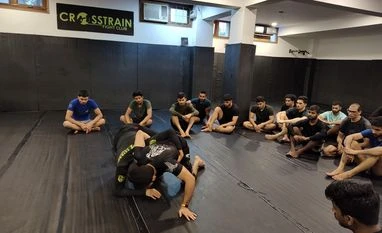
Jiu-jitsu, Crosstrain Fight Club
Trainees at a session in Crosstrain Fight Club, New Delhi
Ritwik Sharma New Delhi
5 min read Last Updated : May 15 2023 | 12:57 PM IST
At the basement of a building in South Delhi’s upscale Sainik Farms, Siddharth Singh shows his wards how they can master “the gentle art” of using their opponent’s force to floor him or her on the mat. Singh is a jiu-jitsu trainer, and as of 2022, he was ranked 11th in the world and fourth in Asia.

Jiu-jitsu, which translates from Japanese as the gentle art or technique, is a grappling sport that is relatively unknown among martial arts in India. Last week, images of Meta Founder Mark Zuckerberg winning a jiu-jitsu competition at the Silicon Valley became a fitting advert for a sport that is slowly emerging out of the shadows of more popular East Asian martial art forms such as karate, kung fu, judo and taekwondo.

Singh, who is India’s highest-ranked jiu-jitsu athlete, testifies it is picking up in the country with a rising interest among youths in mixed martial arts (MMA).

Singh owns the Crosstrain Fight Club, which he started in 2012 after quitting a steady job in the UK. Many of those who trained here have gone on to become professional MMA fighters. MMA combines combat techniques such as striking, grappling and ground fighting. When Singh started the fight club, MMA was still an unfamiliar concept. “Trainers were just teaching karate and calling it MMA,” says Singh.

Jiu-jitsu has since come a long way in India, he says. “People are competing, even pan-India, although there is no real government support yet.”

The sport is not at all violent and involves a lot of thinking and strategy, which Indians naturally gravitate towards, feels Singh. “It is a grappling martial art, like wrestling. We retain 80 per cent of the people who come for trial classes, so the conversion rate for jiu-jitsu is great.”

Crosstrain has two centres, including one in Noida, Uttar Pradesh, besides five affiliates in other cities. Singh estimates that nearly 80 per cent of his clientele join the classes for fitness, health and self-defence, while the rest want to turn pro.

Shalu Sharma, a final-year undergraduate student from Khurja, UP, joined jiu-jitsu classes at Crosstrain three months ago to improve her ground fighting skills. An MMA fighter for five years, she took part in India’s first MMA reality show, Kumite 1 Warrior Hunt, which was hosted by actor Suniel Shetty and aired on MX Player earlier this year.

“Not many women venture into MMA, as it poses threats of cuts and injuries. But I was interested in it since childhood and was encouraged by my father, who was in the army and a wrestler,” says Sharma.

Another of Singh’s students, Tarun Yadav, has won national championships eight times and has been teaching at the fight club for nearly five years. A mechanical engineer, Yadav is set to represent India at the Asian Games in Hangzhou, China, later this year.

The fight club trains members three hours in the morning and nearly five hours in the evening. “We encourage MMA athletes to train twice a day. You can tweak the regimen based on fitness levels,” Yadav says, adding that amateurs also stick with it because it is enjoyable.

Professionals winning at the state or national level are eligible for government grants, like other sports. The grants can be a couple of lakhs of rupees, says Yadav, and vary from state to state but are helpful in motivating athletes to train.

“India does not have a very big jiu-jitsu circuit. But the situation is still much better than five to 10 years ago,” he says. “Because of the introduction of MMA to Indian crowds through the Ultimate Fighting Championship (an American MMA promotion company that organises global tournaments), jiu-jitsu has become more known. Many get into MMA and find that jiu-jitsu is fun and get drawn to it.”

In July 2021, the central government recognised the Ju-Jitsu Association of India (JAI) — which was set up nearly a decade ago — for the sport’s promotion and development in the country.

Chander Mohan Bhatia, a retired naval commander who heads an ethics and legal commission of the JAI, admits that there is a shortage of equipment, coaches and referees currently in India.

“As an organisation, our basic intent was not to hurt aspirants by making it expensive, and we have tried to run JAI on a no-profit, no-loss basis,” he says. Jiu-jitsu, he adds, remains a great entry point for budding sportsmen to get trained in and succeed in other disciplines such as wrestling, judo and karate.

The origins: Japan or ancient India?

Jiu-jitsu’s origins date back to 16th century Japan. More recently, the 20th century version known as ‘Brazilian jiu-jitsu’ has contributed to its popularity.

Experts also suggest ancient India was its birthplace before Buddhist monks introduced the martial art to Japan.

“According to some research, jiu-jitsu is derived from Yuyutsu in the Mahabharata. Yuyutsu was a step-brother of the Kauravas who switched sides and fought for the Pandavas,” says Siddharth Singh, jiu-jitsu trainer and athlete.

From mythology to present-day realities, jiu-jitsu is gently fighting its way to be more than a mere footnote in the world of martial arts in India.


One subscription. Two world-class reads.

Already subscribed? Log in

Subscribe to read the full story →
*Subscribe to Business Standard digital and get complimentary access to The New York Times

Smart Quarterly

₹900

3 Months

₹300/Month

SAVE 25%

Smart Essential

₹2,700

1 Year

₹225/Month

SAVE 46%
*Complimentary New York Times access for the 2nd year will be given after 12 months

Super Saver

₹3,900

2 Years

₹162/Month

Subscribe

Renews automatically, cancel anytime

Here’s what’s included in our digital subscription plans

Exclusive premium stories online

  • Over 30 premium stories daily, handpicked by our editors

Complimentary Access to The New York Times

  • News, Games, Cooking, Audio, Wirecutter & The Athletic

Business Standard Epaper

  • Digital replica of our daily newspaper — with options to read, save, and share

Curated Newsletters

  • Insights on markets, finance, politics, tech, and more delivered to your inbox

Market Analysis & Investment Insights

  • In-depth market analysis & insights with access to The Smart Investor

Archives

  • Repository of articles and publications dating back to 1997

Ad-free Reading

  • Uninterrupted reading experience with no advertisements

Seamless Access Across All Devices

  • Access Business Standard across devices — mobile, tablet, or PC, via web or app

Topics :FitnessMark ZuckerbergMixed Martial Arts

Next Story


