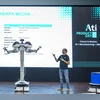
In a quiet corner of Bengaluru’s startup ecosystem, far from the glamour of apps and fintech, Ati Motors is working on what may be India’s most ambitious bet in deep-tech: industrial humanoid robots. The company recently unveiled Sherpa Mecha, a robot built not to replicate humans in form or function, but to surpass them in industrial tasks.
“Most humanoids want to mimic a person as closely as possible,” says Saurabh Chandra, founder and CEO of Ati Motors. “Our approach is different — we want a superhuman.”
Launched at its 2025 Product Day event last week, Sherpa Mecha is the latest addition to Ati’s growing lineup of autonomous systems, which includes Sherpa 10K, a heavy-duty tugger designed to carry up to 5 tonnes in complex warehouse environments. Unlike general-purpose humanoids such as Tesla’s Optimus, Mecha is designed with a narrower mission: industrial performance over physical familiarity.
“We don’t want to do everything,” Chandra says. “But we want Mecha to outperform humans inside an industrial environment… We will be very good at industrial tasks by choosing to be bad at domestic tasks.”
While Sherpa Mecha is the headline product, Ati’s business is firmly rooted in solving real logistics problems across India's growing industrial base. “We are mainly focused on manufacturing plants with automotive (including auto components and tyres) being our largest vertical,” says Chandra. “We are rapidly expanding into FMCG, white goods, electronics, electrical (incl battery and solar) and pharma verticals also.”
In the beginning, there was discontent
Ati Motors began in 2017, born of Chandra’s disenchantment with the software world. After selling his previous company Neev in 2013, he felt unmoved by the cloud and mobile revolution. “The world of cloud, mobile was not challenging enough as an engineer,” he says. “If it doesn't feel challenging technically, then it would get commoditised very soon.”
He saw the early hype in autonomous vehicles, a decade after DARPA’s urban challenge (an autonomous vehicle competition organised by the US’ Defense Advanced Research Projects Agency in 2007). The event was designed to accelerate the development of self-driving cars that could operate safely in complex urban environments., but also sensed its limits. “I got one more thing right,” he says, “that making autonomy work on public roads will take much longer than people were claiming in 2017.” So Ati Motors focused instead on autonomy in structured environments: warehouses and factories.
The insight paid off. “We became an autonomous robot company solving material movement in factories,” says Chandra. “It reminded me that my own final-year college project was optimising material movement on the shop floor. Life comes full circle sometimes.”
Built in India, for the world
The name ‘Ati’ itself is a marker of ambition. “Ati is the Sanskrit/Hindi prefix to denote superlatives, like in ati-sundar,” says Chandra. “The idea was that we will do superlative engineering.”
The engineering at Ati stretches across mechanical, electronics and software domains. “We do many hard things at Ati, but if I have to cite one, then it is the fact that we do so many of them together,” he says.
Sherpa Mecha, for instance, is built on a fully indigenous design, but draws on global supply chains. Its AI stack is developed in-house, but “we do use many open-source frameworks as sub-systems,” Chandra clarifies. “No systems are built in isolation these days, and one does stand on the shoulders of technological progress done to date in the industry.”
But for all its reach, Chandra is clear about the economics of scaling hardware. “Ati is a growth stage startup and will not be profitable for quite some time, with the focus on scaling.”
Currently, the humanoid is being offered to research partners at $50,000 and is expected to enter trial deployments later this year. “We have many customers and partners who are talking to us post our product launch,” Chandra confirms.
Beyond Bengaluru
The company has raised $37 million in venture funding, including a $20 million round led by Walden Catalyst and Nokia Growth Partners in January this year. It now offers both outright sales and subscription models, including for the Mecha platform.
But the ambition doesn’t end with robots. Ati is developing an AI operating system, Ati Verse, to enable its robots to not just move autonomously but also interact with, transform, and manage materials, a key differentiator in industrial automation.
“Mecha is already the 7th robot we have made,” Chandra says. “We are really excited to develop it as a platform and ecosystem in which partners can also participate in making applications.”
How indigenous are Ati Motors’ humanoids?
For all its global outlook, Ati remains rooted in India’s industrial and infrastructural challenges. Chandra is clear-eyed about the country’s readiness for a humanoid leap. “Not enough people are working on this here… one has to rely on connecting to the global community,” he says. “At Ati, we do think of ourselves as a global company, so that is not a roadblock for us.”
Still, he acknowledges that India’s manufacturing environment needs basic fixes. “Cheap and reliable electricity, industrial parks where roads are not broken, taking away poor regulation like making factories mandatorily maintain gardens. The list is long,” he said.
India vs China: Not a level playing field
On policy, Chandra is usually averse to government hand-holding, but says the global field isn’t level, especially when competing with China. “They give subsidies to the industry to buy robots (up to 25 per cent of the value), place large orders from govt organisations, and also provide easy funding (both debt and equity) to robot makers, thus attacking both the demand and supply sides,” he points out.
China’s humanoid-robot market is projected to hit $1.4 billion by 2026 and $10.3 billion by 2029, thanks to over $20 billion in state investment till 2024, coordinated supply chains, and mass deployment across automotive, logistics, and elder-care sectors.
India, in contrast, stands at a measly $75.4 million in 2025, which is expected to grow to $149 million by 2030, far short of even the billion-dollar mark. Despite pioneering efforts by ISRO’s Vyommitra,
DRDO, and companies like Invento and Addverb, Ati remains the only Indian startup attempting a globally scalable humanoid platform.
Chandra is also unfazed by the comparison with Tesla’s Optimus humanoid robots. “Optimus is in the same group of humanoids, trying to be exactly like humans. We will beat it in industrial applications, but not in serving drinks at a party.”