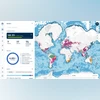
To provide a comprehensive and data-centric resource system for mapping and monitoring the world’s ecosystems, a new tool, the Global Ecosystem Atlas, has been launched at the 16th Conference of Parties (COP) to the United Nations Convention on Biological Diversity (CBD) in Cali, Colombia, by the Group on Earth Observation (GEO).
The new initiative aims to help governments, businesses, financial institutions, and local communities to make informed decisions, support sustainability and manage risks. According to GEO, it will be a game-changer ‘in how we understand, monitor, protect and manage ecosystems’.
What is the Global Ecosystem Atlas?
It is an open-source repository that combines existing high-quality ecosystem maps with new maps, developed by using the latest Earth observation technology, artificial intelligence, field data, and local expertise.
Since it is open-source, it would be freely accessible to all. ‘The simple idea is that earth observation data should be universally accessible to support evidence-based decision making regardless of location or capacity,’ says GEO.
From where the data will be collected?
The new atlas is created by compiling the existing ‘spatial data products’ developed to represent ecosystems. According to GEO, these maps have come from high-quality national, regional, and global repositories.
In order to ensure the credibility of the dataset, it has been subjected to a rigorous evaluation process, including validation and harmonisation with the IUCN Global Ecosystem Typology. It is an internationally recognised system for classifying ecosystems.
How will it help different sectors?
Providing high-quality, reliable and standardised data on ecosystems will help identify key areas for the conservation and restoration of the environment, which can make it an invaluable resource for policymakers, private companies, financial institutions, and local communities.
Since policymakers will have access to reliable data, it will enable them in informed decision making and effective policy development for restoration, and environmental management. Local communities will also be able to manage their land and natural resources effectively by combining traditional knowledge with scientific insights.
For companies, it can help them in incorporating environmental risks into their business strategies. International financial institutions and development banks, which are increasingly looking for sustainable development, can use the data to ensure that the funded project aligns with their sustainability goals.
Has any country adopted this approach in the past?
At the world level, the Global Ecosystem Atlas is a first of its kind. But two countries, South Africa and Mozambique, have adopted this data-centric approach to environmental conservation.
The efforts of South Africa date back many decades, involving many ecologists and a wide range of data sources, resulting in maps of around 1,000 ecosystem types. This wealth of data has benefitted the African nation in conservation action, spatial planning, environmental impact assessments, and more.
With the help of South Africa, Mozambique has also developed ecosystem maps. These maps are vital tools in determining and prioritising areas for conservation and restoration.
With the help of this new Atlas, countries can now align their national data and increase the effectiveness of their conservation initiatives. It will also help in the identification of discrepancies in the mapping of ecosystems at the national level, particularly in the border areas.

 "COP-16: World's 1st global ecosystem atlas unveiled; how will it help biz")


 Connect with us on WhatsApp