Sam Altman, Ashwini Vaishnaw discuss collaboration as AI race hots up

The OpenAI CEO is currently on a whirlwind multi-country tour that started this week
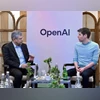
IT Minister Ashwini Vaishnaw speaks with OpenAI's Sam Altman to discuss AI collab
IT Minister Ashwini Vaishnaw speaks with OpenAI's Sam Altman to discuss AI collab | Photo: X
Aashish Aryan New Delhi
4 min read Last Updated : Feb 05 2025 | 11:54 PM IST
India has become the second-largest market (after the US) for OpenAI, the creator of ChatGPT, with its user base growing thrice over in 2024. The pecking order was revealed by OpenAI chief executive officer Sam Altman during a fireside chat with Union Minister of Electronics and Information Technology Ashwini Vaishnaw in New Delhi on Wednesday. Vaishnaw, who also had a closed-door meeting with Altman, indicated in a social media post that India would collaborate with OpenAI on several fronts to develop an AI ecosystem.               
Altman, 39, was on a flying visit to India as part of a multi-country tour to push (artificial intelligence AI). The American entrepreneur’s visit came amid growing competition with other AI platforms such as China’s DeepSeek. 
“Seeing what people are building in India with AI at all the levels of stack, chips, models… you know all of the incredible applications, I think India should be doing everything. It is really quite amazing to see what the country has done and embraced the AI technology,” Altman said during the fireside chat.    
He praised the country’s rapid AI adoption and innovation. Altman’s latest comments come two years after his dismissive stance on India’s generative AI potential raised eyebrows in the country. 
This week, he has already made stops in South Korea and Japan and is expected to visit the United Arab Emirates and Germany over the next three days. 
During his time in India, Altman held discussions with industry leaders, including Paytm Founder-CEO Vijay Shekhar Sharma, Snapdeal Co-Founder Kunal Bahl, Unacademy CEO Gaurav Munjal, Ixigo Group CEO Aloke Bajpai, filmmaker Shekhar Kapur, Peak XV Managing Director Rajan Anandan, and Accel partner Prayank Swaroop.  The OpenAI top executive also hosted an hour-long session with developers. 
Before the fireside chat, Altman and Vaishnaw held a separate meeting lasting nearly 30 minutes, discussing India’s strategy for developing a comprehensive AI ecosystem. Following the meeting, Vaishnaw posted on X, writing: “Had a super cool discussion with @sama on our strategy of creating the entire AI stack — GPUs, models, and apps. Willing to collaborate with India on all three.” 
Altman also sought to clarify comments he had made two years ago in India, when he suggested that while people were free to attempt building foundational AI models to compete with OpenAI and ChatGPT, they would likely fail if they tried to do so for under $10 million.  He, at the time, said it was “hopeless”. 
DeepSeek garnered global attention by developing a competitive AI model beyond Silicon Valley, despite limited resources. The company reported that a single training run for its AI service cost under $6 million. 
“The world has changed since then,” Altman said on Wednesday, pointing to significant developments in AI and “incredible progress with distillation.” 
“We have learnt a lot to do with these small models and reasoning models. It is still not cheap… It is still expensive to train them but it is doable. I think that is going to lead to an explosion of really great creativity. India should be a leader there of course,” he said. 
While the cost of developing cutting-edge AI models continues to rise exponentially, so too does the economic and scientific value they generate, he added. 
Speaking at the fireside chat, Vaishnaw drew a parallel between India’s ambitions in AI and its success in space exploration, citing the country’s Chandrayaan-II mission as an example of cost-effective innovation.  “Our young entrepreneurs, startups, and researchers are really focussed on getting to that next level of innovation which will reduce the cost. Our country sent a mission to the moon at a fraction of the cost that other countries did. Why can’t we have a (foundation) model similarly at a fraction of the cost that many other countries did?,” he said. 
The government is already using AI across multiple departments, using it to address large-scale challenges in health care, education, agriculture, weather forecasting, and disaster management, he noted. 
Altman emphasised that large-scale AI adoption would accelerate as more applications are built on top of existing foundation models. AI and generative AI, he said, remain in the “research assistant” phase, capable of analysing literature and identifying connections.

One subscription. Two world-class reads.

Already subscribed? Log in

Subscribe to read the full story →
*Subscribe to Business Standard digital and get complimentary access to The New York Times

Smart Quarterly

₹900

3 Months

₹300/Month

SAVE 25%

Smart Essential

₹2,700

1 Year

₹225/Month

SAVE 46%
*Complimentary New York Times access for the 2nd year will be given after 12 months

Super Saver

₹3,900

2 Years

₹162/Month

Subscribe

Renews automatically, cancel anytime

Here’s what’s included in our digital subscription plans

Exclusive premium stories online

  • Over 30 premium stories daily, handpicked by our editors

Complimentary Access to The New York Times

  • News, Games, Cooking, Audio, Wirecutter & The Athletic

Business Standard Epaper

  • Digital replica of our daily newspaper — with options to read, save, and share

Curated Newsletters

  • Insights on markets, finance, politics, tech, and more delivered to your inbox

Market Analysis & Investment Insights

  • In-depth market analysis & insights with access to The Smart Investor

Archives

  • Repository of articles and publications dating back to 1997

Ad-free Reading

  • Uninterrupted reading experience with no advertisements

Seamless Access Across All Devices

  • Access Business Standard across devices — mobile, tablet, or PC, via web or app

Topics :Artificial intelligenceOpenAITechnology

Next Story



