Home / Technology / Tech News / Meta builds gesture-based wristband for hands-free device control: Report
Meta builds gesture-based wristband for hands-free device control: Report
Meta's sEMG wristband detects muscle signals to enable gesture-based computer control, helping users with motor disabilities interact with digital systems non-invasively and on the move
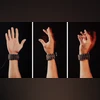
Meta is developing a gesture-controlled wristband that can let users operate computers and digital devices using subtle hand movements. According to a post on the Meta blog, the device uses muscle signals to control actions like moving a cursor, launching apps, and sending messages – all without touching a screen or keyboard.
The wristband is designed to function across a wide range of physical abilities. Users can “write” in the air or on surfaces such as a table or their leg, mimicking pencil-like motion, to compose messages or interact with menus.
Surface electromyography (sEMG): How it works
The core of the technology is surface electromyography (sEMG), a non-invasive method that detects electrical signals generated by muscle activity. These signals, captured by sensors embedded in the wristband, can be interpreted even before a physical gesture is made.
Meta is collaborating with Carnegie Mellon University to test the wristband’s usability for individuals with spinal cord injuries. According to Douglas Weber, professor at Carnegie Mellon's Department of Mechanical Engineering and the Neuroscience Institute, even people with complete hand paralysis exhibit some residual muscle activity, which the device can detect and interpret.
Meta has developed an sEMG wristband prototype that integrates with its Orion AR glasses. This enables users to perform actions like typing, navigating menus, and sending messages hands-free, using only neuromotor signals at the wrist.
The wristband supports gesture recognition such as tapping, swiping, and pinching even when a user’s hand is resting. It also features handwriting recognition, allowing users to write messages by mimicking pen movements on any surface.
Non-invasive: Does not require implants or intrusive hardware
Portable and discreet: Easy to use in public spaces where voice commands may be impractical
Accessibility-focused: Designed to work for users with diverse motor abilities
Future-ready: Supports spatial computing and extended reality use cases
With this technology, Meta aims to make human-computer interaction (HCI) more natural, inclusive, and mobile, unlocking new pathways for accessibility and immersive computing.

 "Meta builds gesture-based wristband for hands-free device control: Report")


 Connect with us on WhatsApp