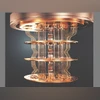
What is Majorana 1, Microsoft's breakthrough in quantum computing?

Majorana 1, the new quantum chip will speed up the production and development of commercially viable quantum computers that can solve industrial scale problems in years from now

Quantum
Aashish Aryan Delhi
4 min read Last Updated : Feb 20 2025 | 9:10 PM IST

Don't want to miss the best from Business Standard?

Technology major Microsoft has announced the world’s first quantum chip built on a topological core, a special category of material it invented and created from scratch after nearly two decades of research and development.
 
Called Majorana 1, the new quantum chip will speed up the production and development of commercially viable quantum computers that can solve industrial scale problems in years from now, instead of the decades that it was supposed to take otherwise.
 
“The qubits created with topoconductors are faster, more reliable, and smaller. They are 1/100th of a millimeter, meaning we now have a clear path to a million-qubit processor,” Microsoft chairman and chief executive officer Satya Nadella said in a post on X (formerly Twitter).
 
What are qubits?
 
Qubits are the fundamental building blocks for quantum computers, like 0 & 1 for classical digital computers. They are created by manipulating the basic matter particles, such as electrons, photons, and atoms. This helps in storing more data per unit, thereby improving the speed of calculation of computers.
 
Instead of the data existing only as binaries of 0 & 1, qubits can also be superimposed on each other and exist simultaneously as both 0 & 1. This allows quantum computers to process much larger volumes of complex data.
 
Qubits, however, are extremely fragile in nature and can be easily disturbed due to electrical or electromagnetic interference. Apart from this, qubits can also be impacted by measurement, which becomes a problem as computing requires measurement.
 
With the invention of topoconductors on which the Majorana 1 quantum chip is built, Microsoft has managed to surround these qubits with chemical compounds that protect against any outside contamination.
 
What are topoconductors on which Majorana 1 has been built?
 
Topoconductors are a new class of material that is used by companies to harness and produce qubits that are small, fast and can be digitally controlled, Microsoft said. The company also developed a new material called Majoranas, which is made up of indium arsenide and aluminum, the company said in a blog.
 
The new material has been developed by Microsoft after nearly two decades of research and development, the company said.
 
“They don’t exist in nature and can only be coaxed into existence with magnetic fields and superconductors. The difficulty of developing the right materials to create the exotic particles and their associated topological state of matter is why most quantum efforts have focused on other kinds of qubits,” Microsoft said.
 
The new quantum chip Majorana 1 contains both qubits as well as surrounding control electronics, can be held in the palm of one’s hand and fits neatly into a quantum computer that can be easily deployed inside Azure datacenters, the company said.
 
But why are quantum computers so important for the world anyway?
 
Ever since their invention, classical analog and digital computers, which function on binaries of 0 & 1 have immensely helped in the progress, research and development of various aspects of science. The chips for these computers, however, are made from silicon, and are called semiconductors.
 
Though semiconductors have been made smaller in size over time and their ability to hold data has increased exponentially, these chips also tend to heat quickly while performing large and complex computations.
 
Companies across the world hope that with quantum computing, they will be able to store and deliver more data per qubit, therefore ensuring that chips are able to perform trillions of complex calculations within seconds, without the issues of overheating of the systems.
 
Apart from this, quantum computers can also be used to accurately and mathematically map with precision how nature behaves and how atoms interact with each other. This, Microsoft said, could help questions such as why materials suffer corrosion or cracks, calculate the properties of catalysts needed to break down pollutants into valuable byproducts or develop non-toxic alternatives, and breakthroughs helping to eradicate global hunger. 

One subscription. Two world-class reads.

Already subscribed? Log in

Subscribe to read the full story →
*Subscribe to Business Standard digital and get complimentary access to The New York Times

Smart Quarterly

₹900

3 Months

₹300/Month

SAVE 25%

Smart Essential

₹2,700

1 Year

₹225/Month

SAVE 46%
*Complimentary New York Times access for the 2nd year will be given after 12 months

Super Saver

₹3,900

2 Years

₹162/Month

Subscribe

Renews automatically, cancel anytime

Here’s what’s included in our digital subscription plans

Exclusive premium stories online

  • Over 30 premium stories daily, handpicked by our editors

Complimentary Access to The New York Times

  • News, Games, Cooking, Audio, Wirecutter & The Athletic

Business Standard Epaper

  • Digital replica of our daily newspaper — with options to read, save, and share

Curated Newsletters

  • Insights on markets, finance, politics, tech, and more delivered to your inbox

Market Analysis & Investment Insights

  • In-depth market analysis & insights with access to The Smart Investor

Archives

  • Repository of articles and publications dating back to 1997

Ad-free Reading

  • Uninterrupted reading experience with no advertisements

Seamless Access Across All Devices

  • Access Business Standard across devices — mobile, tablet, or PC, via web or app

Topics :MicrosoftMicrosoft IndiaMicrosoft Ventures

Next Story